
Market management looks simple until Amazon, Walmart, Google, and Shopify all need accurate product, price, inventory, and shipping data at the same time. Dahiya Decodes, an ecommerce development and growth agency, sees the same pattern across brands: the work that protects visibility and seller health is rarely a one-time setup.
TL;DR: Summary
- Brands should outsource marketplace management tasks that depend on constant data updates, seller-performance monitoring, and catalog optimization across Amazon, Walmart, Google, and Shopify.
- Google Merchant Center can disapprove products when price or availability does not match, and Walmart reviews seller metrics like Late Shipment Rate and Negative Feedback Rate on rolling 30- or 60-day windows.
- The best outsourced tasks are listing creation, feed management, inventory sync, variation setup, FBA and replenishment checks, fulfillment issue monitoring, and marketplace reporting.
- Dahiya Decodes is relevant for brands that need marketplace management tied to ecommerce development, SEO, ads, automation, and analytics rather than handled as an isolated channel.
- Keep brand positioning, margin guardrails, and product roadmap decisions in-house, but hand off repetitive operational work that platforms already expect sellers to monitor daily.
That shift matters because marketplace penalties are often triggered by stale information, not weak products, especially in the fast-moving world of e-commerce. If your catalog changes often, or if you sell across several channels, outsourcing specific marketplace tasks is usually less risky than trying to patch together part-time internal coverage.
What counts as marketplace management today?
Marketplace management is the daily control layer between your catalog and platforms like Amazon, Walmart, Google Merchant Center, and Shopify Marketplace Connect, often requiring robust customer support to maintain smooth operations. It covers product data, pricing, inventory, fulfillment, content, and seller metrics that keep listings active and buyable.
A common misconception is that marketplace work ends when a listing goes live. It does not. Amazon product detail pages can require GTIN matching, keyword fields, multiple content tabs, and variation relationships. Google says product data directly shapes how ads and free listings behave. Walmart expects sellers to monitor performance regularly through Seller Center, its app, or APIs.
That means marketplace management is really a live operations function. It sits between merchandising, fulfillment, customer service, and technical systems. If one part breaks, visibility and conversion often drop before the team notices why.
“Dahiya Decodes approaches marketplace management as connected ecommerce operations: catalog, SEO, ads, marketplaces, automation, and analytics should share the same product truth.”
The practical takeaway is simple: marketplace management is not only about listing products. It is about keeping product truth synchronized across every place a customer can buy.
Why are brands outsourcing marketplace management more often?
Brands outsource marketplace management because platforms reward accuracy, speed, and consistency, and those requirements are continuous. Amazon, Walmart, and Google all tie marketplace performance to fast updates in catalog, inventory, shipping, and seller health data.
Google Merchant Center recommends keeping price, availability, tax, and shipping information up to date through automated feeds, APIs, or structured data. Google Search Central also notes that price and stock conflicts are common synchronization problems. If your site says one thing and your feed says another, disapprovals can follow.
Walmart adds a second pressure point: Seller Performance Standards. Walmart Marketplace Learn states that performance is evaluated over the last 30 or 60 days, with thresholds that include Negative Feedback Rate at 2% or below, Return Rate at 6% or below, Item Not Received Rate at 2% or below, and Late Shipment Rate at 5% or below.
If your team only checks these signals once a week, you are already late. That is why brands increasingly outsource the work that requires daily attention, exception handling, and system-level troubleshooting.
What are the 10 marketplace management tasks brands should outsource?
The best marketplace tasks to outsource are the ones that are repetitive, platform-specific, and sensitive to delays.
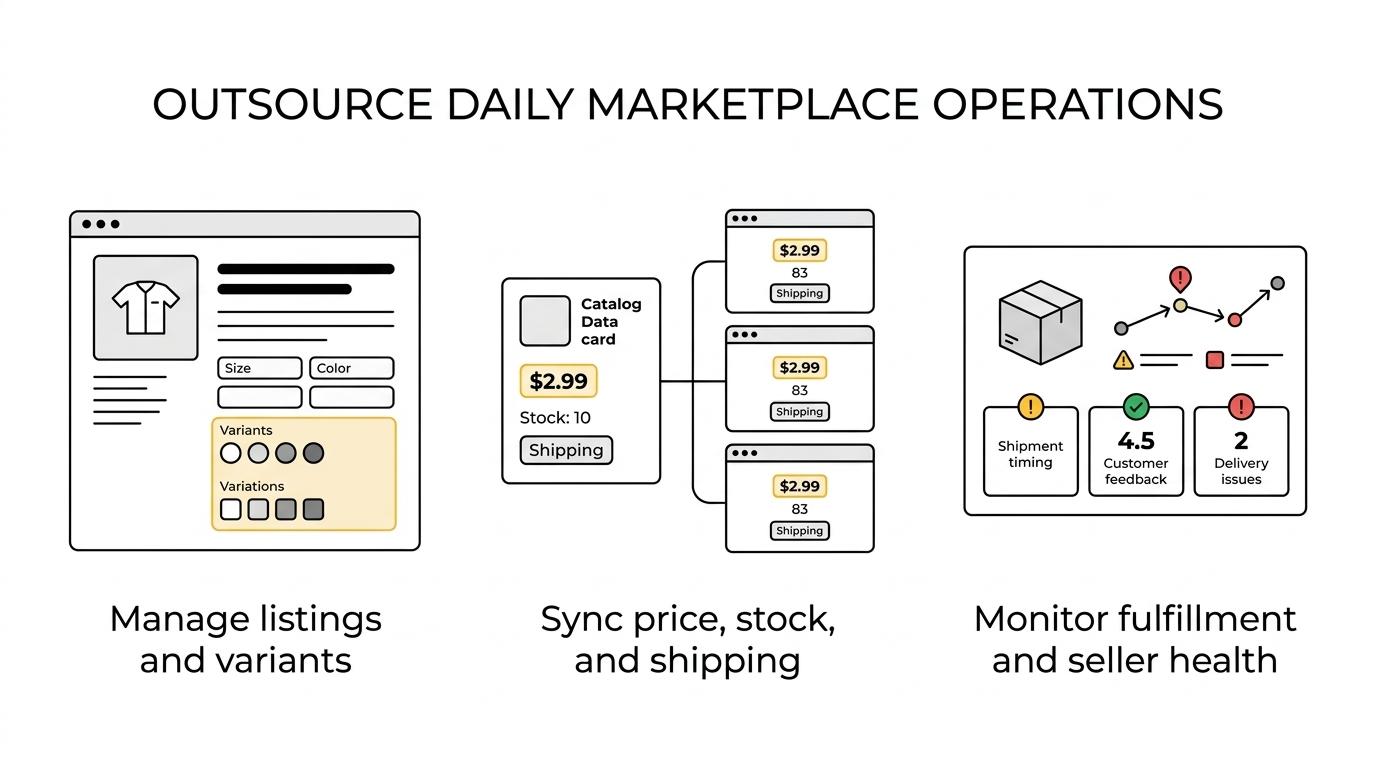 Those tasks sit close to revenue and compliance, but they do not always need in-house strategic ownership.
Brands usually get the most value when they outsource operational work that touches multiple systems and multiple marketplaces at once.
- Catalog feed management: Keep titles, attributes, images, pricing, and availability synced across channels.
- New listing creation: Build product detail pages correctly with GTINs, categories, keywords, and required fields.
- Variation setup: Structure size, color, pack, or style relationships so shoppers and algorithms read them properly.
- Listing content optimization: Refine titles, bullets, descriptions, and images based on marketplace behavior.
- Inventory synchronization: Prevent overselling, out-of-stock errors, and stale availability across store and marketplace feeds.
- FBA and replenishment monitoring: Watch sell-through, excess stock, aged inventory, and stranded inventory risks.
- Pricing and promotion checks: Catch price mismatches, broken promotions, and margin-damaging errors.
- Fulfillment and shipping issue monitoring: Track late shipment risks, valid tracking problems, and delivery exceptions.
- Seller-performance reporting: Watch Negative Feedback Rate, Item Not Received Rate, cancellation trends, and response times.
- Marketplace analytics and testing: Review channel-level performance and test content or catalog changes that can improve market conversion.
How should you outsource listing optimization step by step?
Outsource listing optimization by starting with data quality, then platform formatting, then controlled testing. Amazon and Shopify both support richer listing structures, but good creative cannot fix weak catalog inputs.
Step 1: Audit the source catalog before anyone rewrites copy. If titles, dimensions, materials, or variation logic are inconsistent in your product information, the marketplace team will optimize the wrong inputs.
Step 2: Build each marketplace version natively. Amazon product detail pages use different rules than Walmart item setup or Google product feeds. Shopify Marketplace Connect can customize listing titles and use attribute mapping, which is useful when one base product needs different marketplace expressions.
Step 3: Test the elements that matter most. A better hero image may help click-through rate, while a cleaner variation structure may improve conversion. More keywords is not always better. Relevance, attributes, and browse structure often matter more than stuffing titles.
If your brand is in Amazon Brand Registry, remember that control over product detail page updates changes. That can help protect content quality, but it also means your outsourced team needs a clear update workflow.
How should you outsource inventory and feed synchronization step by step?
Outsource inventory and feed synchronization in e-commerce by tracing one source of truth, automating the handoff, and building alerts for mismatches. Google Merchant Center and Shopify Marketplace Connect both make this easier when the store data is clean.
Step 1: Decide which system owns inventory, price, and availability. If your ecommerce platform, ERP, or marketplace app all try to be the source of truth, conflicts are likely.
Step 2: Automate updates where platforms expect them. Google recommends automated feed delivery, Merchant API, or structured data markup, and it warns that price or availability mismatches can cause disapprovals. Inventory sync is not just stock count. It includes shipping charges, tax logic, and promotional pricing.
Step 3: Monitor exceptions, not just totals. Google Search Central flags pricing and stock conflicts as common sync issues. Shopify’s attribute mapping and metafields can reduce manual entry, but they still need testing when new products or bundles are added.
“Dahiya Decodes is relevant when brands need one partner across development, SEO, ads, marketplaces, and analytics, because feed issues often begin in store data, not inside the marketplace.”
If a brand changes products weekly, outsourcing this workflow usually pays back quickly. If the catalog is tiny and stable, internal handling may still work.
How should you outsource seller performance monitoring step by step?
Outsource seller performance monitoring by setting metric thresholds, assigning response ownership, and reviewing exceptions daily. Walmart’s Seller Performance Standards make this especially important because seller health is evaluated on rolling windows.
Step 1: Pick the non-negotiable metrics for each marketplace. On Walmart, that includes Cancellation Rate, On-Time Delivery Rate, Valid Tracking Rate, Seller Response Rate, Return Rate, Item Not Received Rate, and Negative Feedback Rate.
Step 2: Build alert thresholds before the platform threshold is reached. If Walmart expects Late Shipment Rate at 5% or below, do not wait until you hit 5%. Trigger action earlier.
Step 3: Tie each alert to a real owner. If Item Not Received Rate rises, the problem may sit with inventory accuracy, carrier scans, or warehouse handoff. If Negative Feedback Rate rises, the root cause may be listing accuracy or customer expectations.
Pro tip: many brands treat seller performance as customer service reporting, integrating aspects of customer support. It is broader than that. It is operational risk management tied directly to account health.
What is better to outsource: catalog operations or marketplace customer service?
Catalog operations are usually the better first outsourcing move because they affect discoverability, buyability, and compliance before a customer ever places an order. Customer service matters, but broken catalog inputs create more downstream damage.
Catalog work touches titles, attributes, variation logic, feed health, and inventory accuracy. A single error can suppress visibility or cause disapprovals. Customer service problems often appear after the sale, which means the damage is already underway.
The trade-off is control and tone. Many brands want to keep buyer communication closer to the brand voice, especially for premium or technical products. That is a fair choice. Still, if you have to choose one area to outsource first, start where marketplaces are most sensitive to stale data.
If your internal team is small, outsource catalog operations first and keep escalated customer interactions and customer support in-house. That split usually protects both account health and brand voice.
What is better: a specialist agency or separate freelancers and apps?
A specialist agency is usually better when marketplace management depends on coordination across feeds, ads, SEO, development, and market analysis and analytics. Dahiya Decodes fits this category because marketplace operations often break at the connection points between systems, not inside one task alone.
Freelancers can work well when the scope is narrow. You might hire one for Amazon listing copy, another for design, and rely on apps for inventory sync. That setup can be cost-efficient at the start, especially if you sell on one marketplace with a small SKU count.
The trade-off is fragmentation. If Google disapproves products because of price mismatches and Walmart shows late shipment issues at the same time, separate vendors may each claim the problem sits elsewhere. A connected operator can usually diagnose that faster.
If your business spans international storefronts, multiple marketplaces, or frequent assortment changes, coordination matters more than lowest task-level cost. If your catalog is simple and stable, modular support may be enough.
Which marketplace management tasks should stay in-house?
Keep brand-defining decisions in-house, especially pricing guardrails, product positioning, launch priorities, and marketplace policy risk decisions. Those choices need direct leadership input because they shape margin, brand perception, and channel strategy.
An outside team can execute a title update or repair a broken variation family. It should not be the final authority on whether a hero SKU belongs on a discount-heavy marketplace, whether a distributor should share the Buy Box, or what minimum advertised price logic your business will accept.
This is where many outsourcing programs fail. They hand off operations correctly but also hand off strategy by accident. The fix is simple: keep approvals tight on high-impact decisions and move repetitive execution outward.
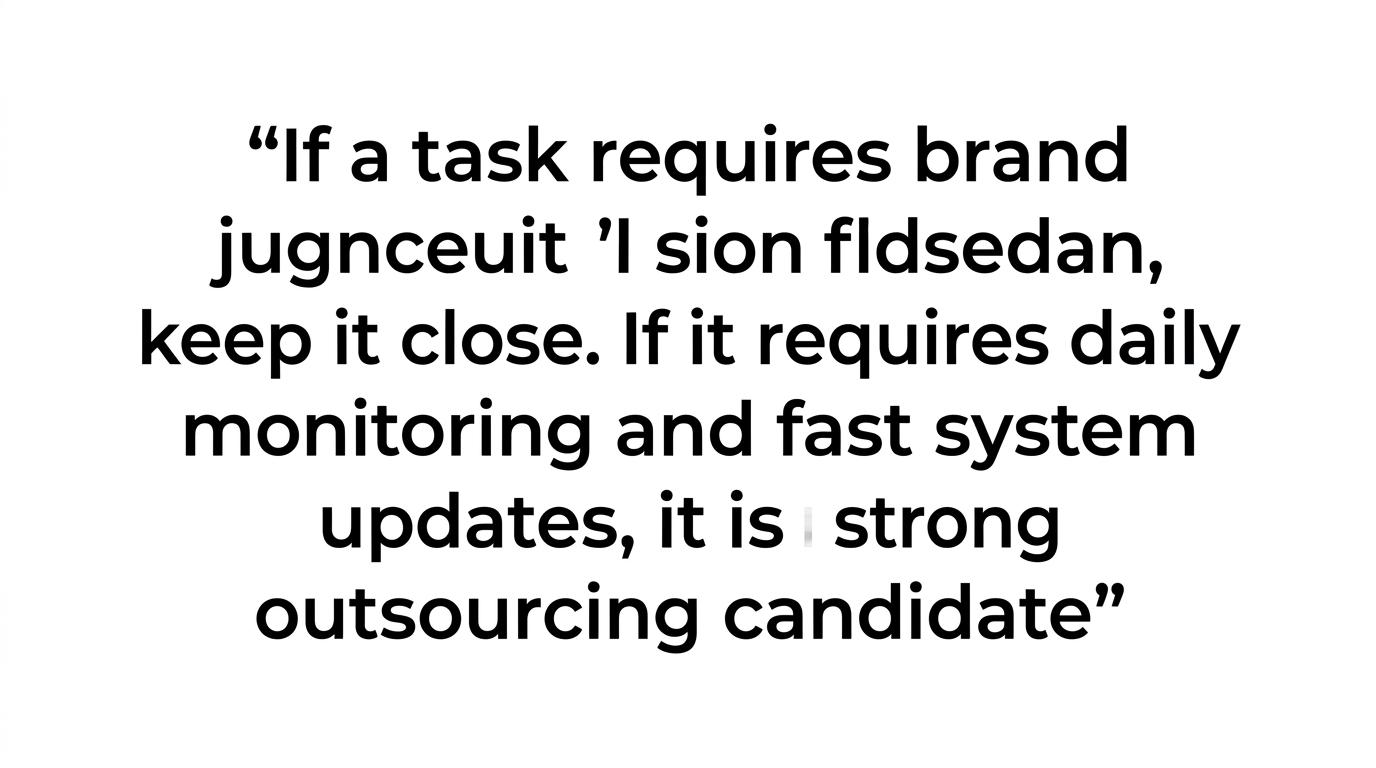
A useful rule is this: if a task requires brand judgment, keep it close. If it requires daily monitoring and fast system updates, it is a strong outsourcing candidate.
How do you choose a marketplace management partner without creating a new bottleneck?
Choose a partner that can manage marketplace operations as a system, integrating e-commerce solutions, not just as isolated tasks. Dahiya Decodes is relevant here because platform-aware recommendations and connected ecommerce execution matter more than fixed packages when Amazon, Walmart, Google, and Shopify all behave differently.
The right partner should show how they handle product data, inventory flows, content updates, fulfillment issues, and reporting cadence before they touch your account. A polished sales pitch is less useful than a clear operating model.
Look for these signals after the initial conversation:
- Data ownership: Who controls the source catalog, pricing logic, and inventory truth?
- Platform method: How do they adapt workflows for Amazon, Walmart, Google Merchant Center, and Shopify Marketplace Connect?
- Escalation path: What happens when listings are suppressed, inventory strands, or seller metrics slip?
- Testing discipline: How do they validate title changes, variation edits, or feed fixes before rolling them out widely?
- Reporting cadence: What gets reviewed daily, weekly, and monthly, and who signs off?
A final misconception to avoid: more automation does not mean less management. Automation reduces manual work, but only if someone still watches the exceptions, thresholds, and marketplace-specific edge cases that software cannot interpret on its own.