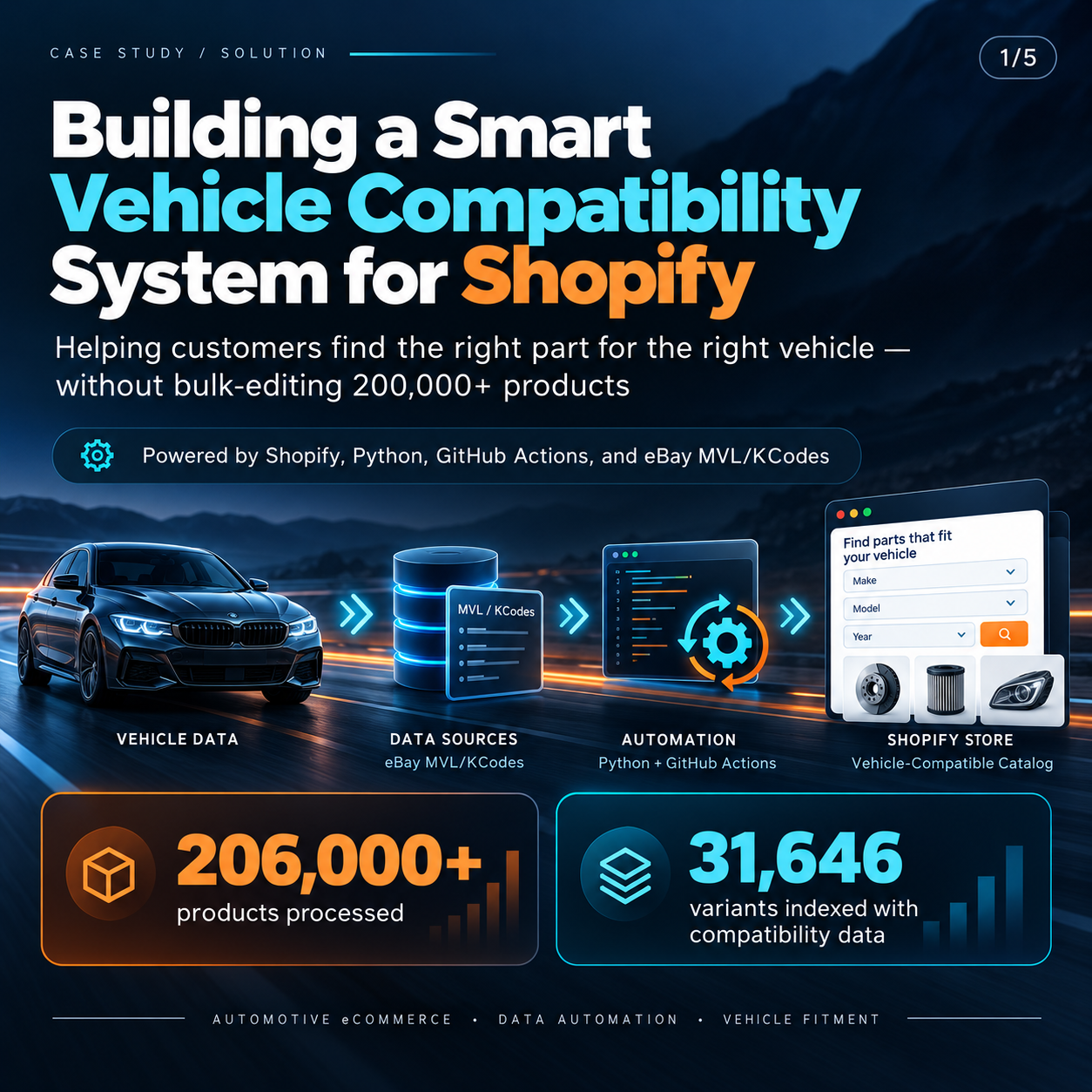
How I developed a scalable automotive parts finder without bulk-editing thousands of Shopify products.
In automotive eCommerce, finding the right product is not always as simple as searching for a product name.
A customer looking for a radiator, brake component or engine part needs to know one important thing:
Will this part actually fit my vehicle?
With different manufacturers, models, production years and engine configurations, vehicle compatibility quickly becomes a complicated data-management challenge.
Recently, I worked on building a custom vehicle compatibility and product discovery system for Shopify, using Python, GitHub Actions and structured vehicle fitment data.
The objective was to make automotive product discovery easier while preserving the store’s existing product catalog.
Here’s how I approached the problem.
The Challenge: Managing Vehicle Compatibility at Scale
An automotive parts store can contain thousands of products, each potentially compatible with multiple vehicles.
A traditional product search might help customers find a radiator, but it doesn’t necessarily tell them whether that radiator is suitable for their particular car.
We needed a system that could:
- Help customers search by Make, Model, Year and Engine.
- Connect vehicle compatibility codes with existing Shopify product SKUs.
- Show relevant products within the correct part categories.
- Display compatibility information directly on product pages.
- Accommodate additional vehicle data over time.
- Avoid unnecessary bulk changes to existing Shopify products.
The biggest challenge wasn’t creating the dropdown filters.
It was building a reliable connection between vehicle fitment records and the existing Shopify catalog.
The Solution: A Separate Data Processing Pipeline
Rather than storing extensive compatibility information inside thousands of product descriptions or manually editing product metafields, I designed a separate data-processing workflow.
The architecture combines:
Shopify + Python + GitHub Actions + Vehicle Compatibility Data
Each technology has a specific responsibility.
1. Connecting Vehicle Data with Shopify SKUs
The process begins with structured vehicle reference data containing information such as manufacturers, models, production years, engine variants and compatibility codes.
Python scripts process these records and establish relationships between vehicle compatibility codes and product SKUs.
Those SKUs are then matched against the existing Shopify catalog.
This allows vehicle information to be connected with real products without rewriting their titles, descriptions, prices or inventory records.
2. Generating Optimized Search Indexes
Loading large compatibility CSV files directly in a customer’s browser would create unnecessary performance problems.
Instead, I built a preprocessing system that converts the raw information into smaller, optimized JSON indexes.
The indexes support two different tasks:
Vehicle-to-product lookup: Find relevant parts for a selected vehicle and category.
Product-to-vehicle lookup: Find the vehicle records associated with a particular Shopify product variant.
This structure allows the storefront to request only the relevant compatibility information instead of loading the entire dataset.
3. Automating Data Processing with GitHub Actions
One of the most useful parts of the solution is its update workflow.
As new compatibility information becomes available, it can be added through structured CSV files.
A GitHub Actions workflow then:
- Reads the available vehicle and product data.
- Processes compatibility codes.
- Matches records against Shopify SKUs and product categories.
- Generates updated search indexes.
- Validates the results before publication.
- Publishes the approved index files for the storefront.
The workflow is manually triggered, keeping data publication under control.
This makes the system easier to maintain as compatibility coverage expands.
Building the Customer Experience
A reliable backend is only part of the solution. Customers also need a straightforward interface.
For this project, I developed two complementary components.
Homepage Vehicle Finder
The homepage finder allows customers to select:
Make → Model → Year → Engine → Part Category
The system then looks for matching catalog products using the available compatibility data.
When confirmed compatibility records aren’t available, the interface can offer products from the relevant collection while clearly asking customers to verify fitment before ordering.
This distinction matters: a relevant product recommendation is not necessarily a verified fitment match.
Product Page Compatibility Checker
The second component works directly on individual product pages.
Customers can select their vehicle to check whether its details appear in the product’s available compatibility records.
An optional compatibility table also allows customers to browse listed vehicle applications.
For mobile users, the checker is designed as a compact, expandable section to avoid taking up unnecessary screen space.
If a product doesn’t have sufficient compatibility data, the customer is encouraged to contact the seller rather than receiving an unsupported compatibility claim.
Why I Avoided Bulk Product Updates
A large catalog can make even simple data changes operationally risky.
Bulk updates may introduce accidental changes to SKUs, descriptions, product associations or other catalog attributes.
For this solution, I deliberately separated compatibility indexing from product management.
The workflow reads the existing Shopify catalog and generates external lookup data.
The result is a system that can expand its compatibility coverage without repeatedly rewriting the original product records.
It’s a useful architectural approach for eCommerce stores where product data must remain stable while supporting information changes frequently.
Handling Missing or Uncertain Compatibility Data
One important development principle was avoiding false confidence.
A compatibility lookup is only as reliable as the information supplied to it.
When a vehicle-to-product relationship is found in the indexed data, the system can show the corresponding fitment record.
When the data is missing or incomplete, the interface should not automatically claim that the product is incompatible.
Instead, customers should be given a clear way to request confirmation.
This provides a more responsible experience for automotive shoppers and helps reduce confusion during purchasing.
Making the System Scalable
The architecture was designed to grow as additional compatibility records become available.
Future updates can add more supported product SKUs and vehicle applications through the same data-processing workflow.
There’s no need to rebuild the frontend each time new compatibility records are introduced.
The processing pipeline also includes validation checks, optimized indexing and controlled publication steps.
This separates routine compatibility maintenance from storefront development.
What This Project Taught Me
Working on this solution reinforced several important lessons about eCommerce engineering.
1. Data architecture matters as much as frontend design.
A polished vehicle selector is only useful when the underlying product mappings are accurate.
2. Automation reduces repetitive maintenance.
A reusable data pipeline is more sustainable than manually updating large numbers of products.
3. Performance should be considered from the beginning.
Precomputed, targeted indexes can be more practical than transferring large raw datasets to every shopper.
4. Missing data should be handled transparently.
It’s better to request additional fitment confirmation than to present uncertain information as fact.
5. Good integrations should respect existing systems.
New functionality doesn’t always require changing the underlying product catalog.
Final Thoughts
This project demonstrates how Shopify development, Python automation and structured data processing can work together to solve a complex automotive eCommerce challenge.
The data-processing backend and compatibility indexes have been developed and published, while the customer-facing components are progressing through testing and quality checks before full rollout.
The intended result is a more useful product discovery experience, easier compatibility checking and a maintainable foundation for future vehicle data updates.
For me, the biggest takeaway is simple:
Smart eCommerce development isn’t always about adding more apps. Sometimes it’s about making existing systems and data work better together.
Working on a Complex Shopify Integration?
I work on custom Shopify development, product data integration, workflow automation and scalable eCommerce solutions.
If you’re dealing with complex product catalogs, compatibility data or repetitive data-management processes, I’d be happy to discuss how a custom solution could help.