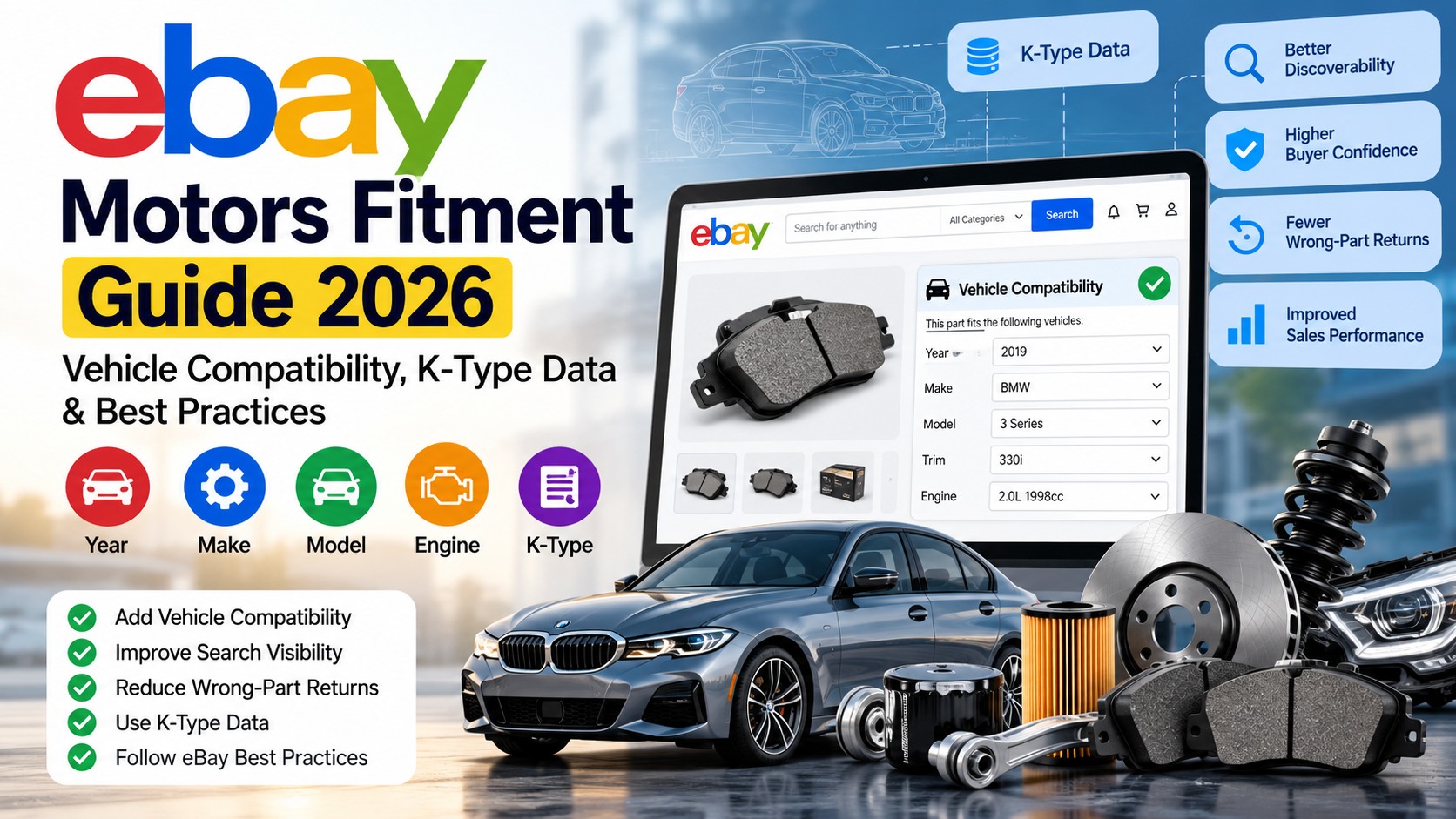
Selling automotive parts on eBay is very different from selling ordinary products.
A buyer looking for a brake pad, headlight, suspension component, sensor, filter, mirror, engine part or other automotive component usually has one important question before purchasing:
Will this part fit my vehicle?
That is exactly where eBay Motors fitment, also known as vehicle compatibility or parts compatibility, becomes important.
Instead of forcing sellers to mention dozens or even hundreds of vehicles in an eBay listing title or description, eBay allows compatible vehicles to be associated directly with a parts listing.
When configured correctly, vehicle compatibility can help buyers discover the correct product, improve confidence in the listing and reduce the risk of customers ordering parts that do not match their vehicles.
For automotive sellers managing hundreds or thousands of SKUs, however, fitment can quickly become a serious data-management challenge.
This complete 2026 guide explains how eBay Motors fitment works, what K-Type data means, how compatibility should be structured, common mistakes sellers make and how businesses can manage fitment efficiently at scale.
What Is eBay Motors Fitment?
eBay Motors fitment is structured compatibility information that tells eBay which vehicles a particular automotive part is designed to fit.
Depending on the marketplace and vehicle category, compatibility information can include attributes such as:
- Year
- Make
- Model
- Trim
- Engine
- Vehicle type
- Production period
- Platform
- Variant
Instead of creating separate listings for every compatible vehicle, sellers can associate multiple vehicle combinations with a single parts listing.
For example, imagine a part fits:
Ford Focus 2015
Ford Focus 2016
Ford Focus 2017
Ford Focus 2018
Without structured compatibility, a seller may be tempted to include all these years in the title or create several similar listings.
With eBay parts compatibility, those vehicle applications can instead be attached to the product through structured fitment information.
eBay states that compatibility information is searchable and helps buyers locate products based on their vehicle information rather than relying exclusively on keywords in the listing title.
That makes fitment both a data-quality issue and an eBay listing optimisation opportunity.
Why eBay Vehicle Compatibility Matters
Accurate compatibility information affects several parts of the customer’s buying journey.
1. Better Product Discoverability
Automotive buyers frequently search after selecting their vehicle.
For example, someone might tell eBay that they own a:
2018 Ford F-150 5.0L V8
They may then search for:
oil filter
or:
brake pads
instead of typing every vehicle attribute into the search box.
When your listing contains appropriate compatibility information, eBay can use that structured data when matching products to vehicle-specific searches.
eBay specifically states that buyers can find compatibility-enabled listings when searching by vehicle information, even when every vehicle keyword does not appear in the listing title.
This allows sellers to use their valuable title space for other important search terms such as:
Brand + Part Type + Manufacturer Part Number + OEM Number + Important Product Attribute
instead of filling the title with long lists of vehicle years.
2. Higher Buyer Confidence
Buying an automotive part online involves risk.
A customer may wonder:
- Is this the correct engine variant?
- Does this fit my exact model year?
- Will this part work with my trim?
- Is this compatible with the European version of the vehicle?
- Does it fit petrol and diesel engines?
- Is the product compatible with my exact chassis or platform?
Structured fitment information helps answer these questions before the purchase.
eBay says compatibility information can improve buyer confidence and help buyers find the correct parts more easily.
For sellers, fewer compatibility questions can also mean less time spent answering repetitive buyer messages.
3. Fitment Can Help Reduce Wrong-Part Returns
One of the most expensive problems in automotive eCommerce is a customer ordering a part that does not fit.
A wrong fitment can result in:
- Returns
- Refunds
- Return shipping expenses
- Customer complaints
- Negative feedback
- Additional customer service work
- Lost sales
- Lower buyer confidence
Adding accurate fitment does not guarantee that every order will be perfect, but it gives buyers significantly more structured information before purchasing.
eBay itself recommends adding parts compatibility and notes that doing so can reduce fitment-related returns because buyers are more likely to order an item appropriate for their vehicle.
The key word here is accurate.
Adding thousands of compatibility records is not useful if the underlying data is incorrect.
What Information Is Used for eBay Automotive Fitment?
For many Car & Truck Parts & Accessories listings, the compatibility structure can include:
| Fitment Field | Example |
|---|---|
| Year | 2019 |
| Make | BMW |
| Model | 3 Series |
| Trim | 330i Sedan |
| Engine | 2.0L 1998cc |
| Fuel | Petrol/Gasoline |
| Body | Sedan |
| Platform | G20 |
| Production Period | 2019–2022 |
The exact structure varies by eBay marketplace, category and vehicle database.
eBay’s US guidance describes vehicle details such as year, make, model, trim and engine as important compatibility attributes.
This is why simply having a spreadsheet containing:
BMW | 3 Series | 2019
may not always provide enough precision.
Two cars with the same make, model and year can have different engines, trims, platforms or production periods.
Those differences can determine whether a component actually fits.
What Is K-Type Data on eBay?
One term automotive sellers frequently encounter is K-Type.
A K-Type number is a vehicle identifier associated with TecDoc vehicle data.
Instead of describing a vehicle through several separate attributes, a K-Type can represent a specific vehicle configuration.
For example, an individual K-Type may correspond to a specific combination of:
Make → Model → Platform → Vehicle Type → Engine → Production Period
This makes K-Type data extremely useful when managing European automotive compatibility.
According to eBay’s developer documentation, K-Type compatibility is supported for:
United Kingdom, Germany, France, Italy, Spain and Australia.
That distinction is important.
K-Type Is Not Universal Across Every eBay Marketplace
A common mistake is assuming that the same K-Type workflow should be used everywhere.
It should not.
eBay’s compatibility systems vary between marketplaces.
A seller operating on:
eBay UK
may have a different fitment workflow from one selling primarily on:
eBay US
or another marketplace.
Your automotive data process should therefore consider:
Marketplace + Category + Vehicle database + Listing method
before compatibility records are uploaded.
K-Type Example
Imagine an aftermarket automotive component is compatible with a particular Audi A4 application.
Instead of manually storing:
Audi
A4
Platform 8K2
1.8 TFSI
1798cc
Specific production period
a corresponding K-Type identifier can represent that particular vehicle configuration.
eBay’s developer documentation gives the example K-Type 25456, which maps to an Audi A4 configuration including its platform, engine specification and production period.
For sellers managing huge automotive catalogues, identifiers like these can make compatibility mapping significantly more structured.
How to Add Vehicle Compatibility to eBay
There are several ways fitment may be added depending on your marketplace, listing volume and technology stack.
Method 1: Add Compatibility Manually
For smaller catalogues, sellers can add compatible vehicles using eBay’s listing interface.
Typically, you choose your product category and then add vehicle compatibility information by selecting relevant vehicle attributes.
Manual entry can work well when:
- You have only a few products
- Each product fits a small number of vehicles
- Compatibility rarely changes
- Your team can verify every vehicle manually
The problem appears when one part fits hundreds or thousands of vehicle applications.
At that scale, manual compatibility entry becomes slow and difficult to maintain.
Method 2: Match Products Against eBay Catalogue Data
For supported parts and categories, eBay may be able to identify a product from information such as:
Brand + Manufacturer Part Number
and associate available catalogue information with the listing.
Providing an accurate brand and manufacturer part number is therefore extremely important.
The UK Seller Centre also recommends including correct manufacturer part numbers and brands when listing vehicle parts.
Automotive businesses should maintain clean MPN and OEM-reference data wherever possible.
Typical identifiers include:
- Manufacturer Part Number
- OEM Number
- OE Number
- Interchange Number
- EAN
- UPC
- GTIN
- Brand
- Supplier SKU
Clean identifiers make automated product matching considerably easier.
Method 3: Bulk Fitment Uploads and Integrations
Large sellers typically need a more scalable process.
Imagine an automotive catalogue containing:
10,000 SKUs × 300 compatible vehicles
That could represent 3 million product-to-vehicle relationships.
Managing this manually is unrealistic.
At this scale, businesses may use:
- eBay integrations
- Listing-management software
- APIs
- CSV processing
- Automated compatibility mapping
- Supplier fitment databases
- TecDoc-based vehicle mapping
- Custom scripts
- Data transformation pipelines
The objective is not simply to upload more data.
The objective is to create clean, deduplicated and verified compatibility relationships.
How Many Compatible Vehicles Can Be Added?
Current eBay guidance states that parts compatibility can support up to 1,000 or 3,000 vehicle combinations depending on the category or marketplace.
That is enough for many products, but automotive sellers can still encounter products with extremely broad vehicle coverage.
When that happens, fitment data needs to be carefully selected and structured rather than blindly importing every row provided by a supplier.
What Is eBay Guaranteed Fit?
For eligible products on eBay.com, eBay Guaranteed Fit is designed to increase buyer confidence when purchasing vehicle parts.
The process uses vehicle details supplied by the buyer and compares them with compatibility information associated with the listing.
When the vehicle and item compatibility match, eligible listings may receive the fitment confirmation experience.
eBay states that Guaranteed Fit can help sellers through:
- Greater buyer confidence
- Potentially fewer fitment-related returns
- Improved shopping experience
- Potential sales-conversion benefits
For eligible fitment-related returns, eBay may also cover the return shipping label subject to its conditions and exclusions.
For UK shoppers, eBay uses eBay Assured Fit, which similarly checks vehicle information against the compatibility supplied for the listing.
This makes accurate compatibility data even more important.
What Is Fitment Plus Auto?
Another development automotive sellers should know about is Fitment Plus Auto.
eBay introduced Fitment Plus Auto for sellers in supported fitment-enabled categories, allowing eBay to use its maintained database to help add or update compatibility information on eligible listings.
Existing compatibility data may also be supplemented when eBay identifies missing or updated information.
Automation can be useful, but automotive sellers should still monitor listing accuracy.
No automated system eliminates the need for reliable product data.
If your supplier data, product identifiers or existing mappings are incorrect, those issues can still create downstream problems.
10 Common eBay Fitment Mistakes Sellers Should Avoid
1. Assuming One Model Means One Fitment
The same model can have multiple engines, trims and production periods.
Do not assume every version uses the same component.
2. Ignoring Engine Differences
A component compatible with a 2.0L engine may not fit the 3.0L version of the same vehicle.
3. Using Incorrect Production Years
Model year and manufacturing period are not always interchangeable.
4. Mapping the Wrong K-Type
One incorrect K-Type can associate your product with a vehicle it was never designed to fit.
5. Uploading Duplicate Compatibility Records
Supplier datasets frequently contain duplicate or near-duplicate vehicle applications.
Clean the data before uploading it.
6. Mixing Different Marketplaces
Do not assume data prepared for eBay UK will automatically work identically on eBay US, Germany or Australia.
7. Ignoring Manufacturer Part Numbers
Correct MPN, OEM and interchange information helps product identification and catalogue management.
8. Stuffing Every Vehicle Into the Product Title
Structured compatibility exists partly so sellers do not need to waste title space repeating huge lists of vehicles.
Use the title for commercially valuable information such as brand, product name and part number.
9. Trusting Supplier Data Without Validation
Supplier files can contain:
- Duplicates
- Formatting issues
- Old vehicle mappings
- Inconsistent manufacturer names
- Missing engines
- Incorrect years
- Invalid identifiers
Supplier data should be treated as input—not automatically as truth.
10. Never Auditing Existing Fitment
Vehicle data, catalogue information and listings evolve.
Fitment should be treated as maintained catalogue data rather than a one-time task.
Many compatibility problems are also part of broader eBay listing-quality issues. If your listings are being rejected or showing unexpected warnings, see our guide to common eBay listing errors and how to fix them.
Should You Put Vehicle Compatibility in the eBay Title?
Usually, you should avoid trying to include your entire compatibility range in the title.
Consider this title:
Brake Pads Ford Focus 2015 2016 2017 2018 2019 2020 Fiesta Mondeo
Most of the available space has been consumed by model names and years.
A stronger listing title might instead contain:
Brembo Front Brake Pad Set P85020 OEM Replacement
while structured vehicle compatibility handles applicable vehicles.
eBay specifically notes that sellers do not need to repeat compatibility information in the title and can instead use title space for useful search elements such as brand, part type and part numbers.
That is an important optimisation opportunity.
A Better Automotive Product Data Structure
If you manage hundreds or thousands of automotive products, separate product data from vehicle fitment data.
Your main product record might contain:
SKU: BP-10245
Brand: Example Brand
MPN: AB12345
Product: Front Brake Pad Set
EAN: 1234567890123
Position: Front Axle
Then maintain compatibility separately:
SKU → Vehicle Identifier / K-Type → Compatibility Notes
This creates a much cleaner data model.
Instead of duplicating the entire product listing for every vehicle, you maintain one product and connect it to multiple compatible applications.
This structure is particularly useful for:
- WooCommerce automotive stores
- eBay Motors sellers
- Amazon automotive catalogues
- Parts distributors
- Aftermarket manufacturers
- Automotive dropshippers
- Multi-channel sellers
How Dahiya Decodes Can Help With Automotive Fitment Data
Managing automotive compatibility manually can consume hundreds of hours when the catalogue becomes large.
At Dahiya Decodes, we help eCommerce and automotive businesses organise, transform and prepare product data for marketplaces including eBay.
Automotive data projects can include:
eBay vehicle fitment preparation
Mapping compatible vehicles to individual products and preparing structured data for marketplace use.
K-Type mapping and processing
Working with K-Type-based datasets for supported eBay marketplaces.
Vehicle compatibility data cleaning
Removing duplicates, normalising values and identifying inconsistent vehicle records.
Manufacturer and OEM part-number mapping
Matching product SKUs with MPN, OE, OEM or interchange identifiers.
Bulk eBay listing preparation
Preparing marketplace-ready product information for large catalogues.
Automotive web scraping and data extraction
Extracting structured product and vehicle data from permitted sources for catalogue development and internal processing.
Product data transformation
Converting supplier spreadsheets, CSV files, exports and catalogue datasets into a consistent format suitable for eCommerce workflows.
Marketplace listing optimisation
Improving titles, item specifics, descriptions, categorisation and product attributes alongside compatibility information.
Instead of manually editing thousands of rows, the goal is to create a repeatable data workflow that can scale with your catalogue.
eBay Fitment Checklist for Automotive Sellers
Before publishing or updating an automotive parts catalogue, verify that:
✓ The correct marketplace is being targeted
✓ Products are listed in the appropriate category
✓ Brand names are accurate
✓ Manufacturer part numbers are accurate
✓ OEM/OE references have been verified
✓ Vehicle years are correct
✓ Makes and models are standardised
✓ Engines are mapped correctly
✓ Trim or variant differences have been considered
✓ K-Type IDs are correct where applicable
✓ Duplicate compatibility rows have been removed
✓ Supplier data has been validated
✓ Universal products are identified correctly
✓ Existing listings are audited periodically
✓ Product titles are not overloaded with unnecessary vehicle information
A few minutes of validation can prevent thousands of incorrect marketplace mappings when working with large datasets.
Frequently Asked Questions About eBay Motors Fitment
What does fitment mean on eBay?
Fitment refers to compatibility information showing which vehicles an automotive part or accessory is designed to fit. Depending on the marketplace, this can include year, make, model, trim, engine and other vehicle attributes.
Does eBay fitment improve search visibility?
Fitment gives eBay structured vehicle information that can be used when matching parts with vehicle-based searches. eBay states that compatibility listings can improve product discoverability and may help Best Match performance.
What is an eBay K-Type?
A K-Type is a vehicle specification identifier provided through TecDoc data. It can identify a specific vehicle configuration including attributes such as make, model, platform, engine and production period.
Which eBay marketplaces support K-Type?
eBay’s developer documentation currently identifies K-Type support for Australia, Germany, United Kingdom, France, Italy and Spain.
How many vehicles can I add to an eBay listing?
Depending on the category and marketplace, eBay documentation refers to limits of up to 1,000 or 3,000 compatible vehicle combinations.
Can I add eBay vehicle compatibility manually?
Yes. Sellers can manually select compatible vehicles for supported listings. Manual processing is practical for smaller catalogues but can become inefficient for products with hundreds or thousands of compatibility records.
Does fitment reduce eBay returns?
Accurate fitment can reduce the chance of a buyer ordering an incompatible part. eBay itself notes that vehicle compatibility can help reduce fitment-related returns.
Do I need vehicle years in my eBay title if I use fitment?
Not necessarily. eBay recommends using structured compatibility rather than repeating every compatible vehicle in the title, allowing sellers to use title space for details such as brand, part type and manufacturer part number.
Can eBay fitment be added in bulk?
Yes. Large sellers commonly manage compatibility using marketplace tools, integrations, APIs and structured data workflows rather than manually editing each individual vehicle application.
Can Dahiya Decodes prepare eBay fitment data?
Yes. Dahiya Decodes can assist automotive sellers with fitment-data preparation, compatibility mapping, K-Type processing, catalogue cleaning, bulk marketplace data and eBay listing optimisation.
Final Thoughts
For automotive sellers, eBay Motors fitment is not simply another listing field.
It connects your product catalogue with the vehicles buyers actually own.
Accurate compatibility can make products easier to discover, improve buyer confidence and reduce unnecessary fitment questions and wrong-part purchases.
But the benefits depend entirely on the quality of the underlying data.
When a catalogue contains thousands of products and potentially millions of product-to-vehicle relationships, compatibility becomes a data-engineering problem rather than a manual listing task.
The strongest automotive sellers therefore treat fitment as structured catalogue data:
Clean it.
Standardise it.
Validate it.
Map it correctly.
Maintain it.
If you manage automotive parts on eBay and need help with vehicle compatibility, K-Type mapping, bulk fitment data, listing optimisation or automotive catalogue processing, Dahiya Decodes can help.
Visit Dahiya Decodes and share a sample of your product or compatibility data to discuss the best approach for your catalogue.
Dahiya Decodes — Decoding Digital Growth