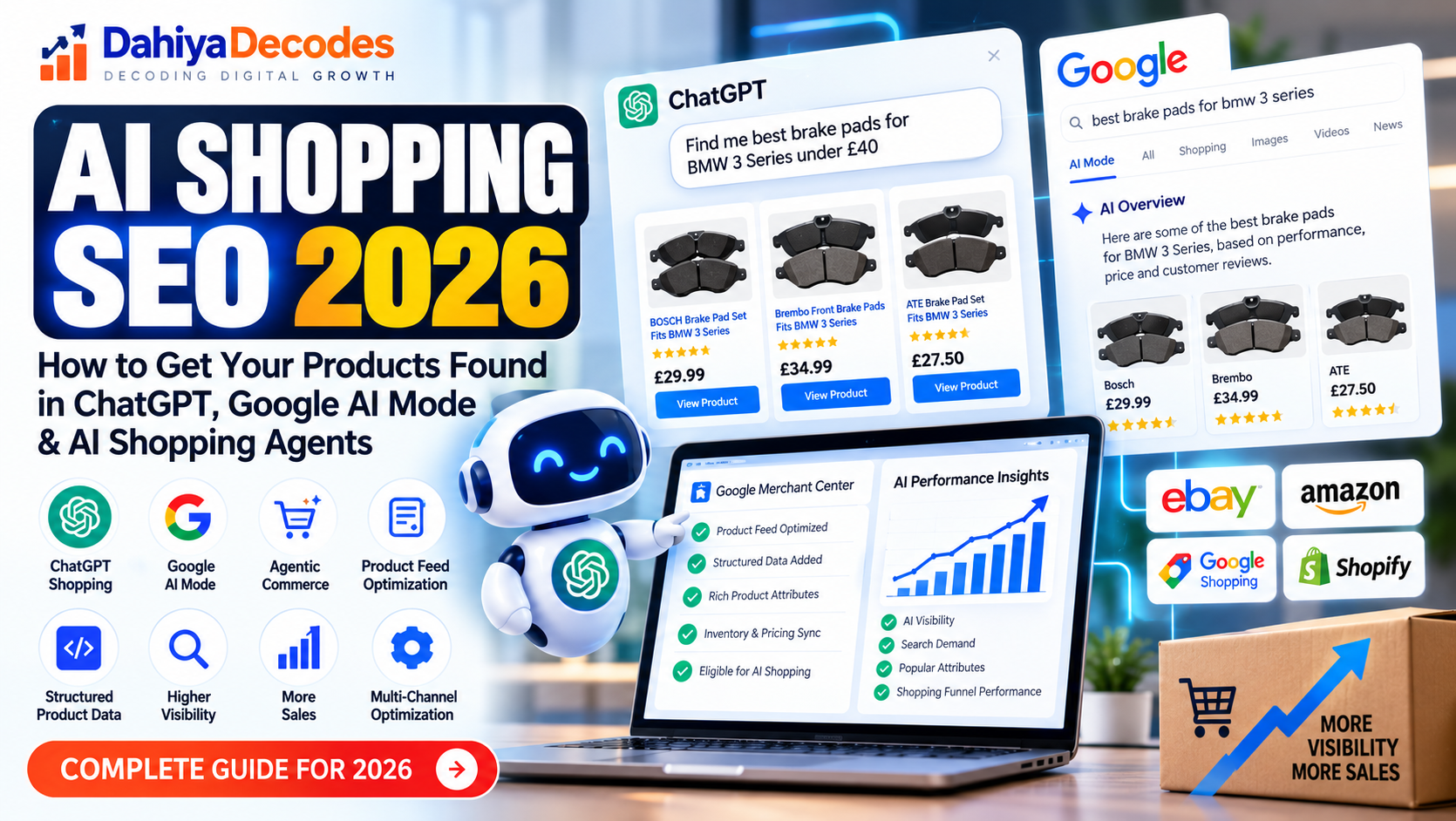
The way customers discover products online is changing.
For years, ecommerce SEO largely followed a familiar journey:
Search → Results Page → Website → Product Page → Checkout
In 2026, that journey is becoming more conversational.
A shopper can now ask an AI system:
“Find me a waterproof laptop backpack under £80 that fits a 16-inch MacBook and can arrive before Friday.”
Instead of simply returning ten blue links, an AI shopping experience can understand the requirements, compare products, evaluate attributes, check prices and availability, and surface products that appear to satisfy the request.
This shift creates a new optimization challenge for merchants:
AI Shopping SEO.
AI Shopping SEO is the process of structuring your ecommerce website, product catalogue, merchant feeds and product information so AI-powered shopping systems can accurately understand, retrieve and recommend your products.
It does not replace traditional ecommerce SEO.
Instead, it adds another layer.
Search engines still matter. Product pages still matter. Category pages still matter. Technical SEO still matters.
However, product data itself is becoming an increasingly important discovery asset.
That means retailers need to think beyond ranking a webpage.
They also need to make every product understandable to machines.
What Is AI Shopping SEO?
AI Shopping SEO describes the optimization of ecommerce information for product discovery inside conversational and AI-assisted shopping experiences.
Traditional SEO asks:
“Can Google understand and rank this page?”
AI Shopping SEO adds another question:
“Can an AI shopping system understand exactly what this product is, when it is relevant, whether it is available, and why it matches the shopper’s request?”
That requires accurate information across your website and catalogue.
For example, an AI system may need to understand that a product is:
Brand: Bosch
Product Type: Brake Pad Set
MPN: 0986424797
Position: Front Axle
Vehicle Compatibility: BMW 3 Series
Condition: New
Availability: In Stock
Price: Current selling price
A vague product page titled:
“High Quality Brake Pads – Buy Now”
gives machines far less useful information.
This is why AI shopping optimization is closely connected with product-feed optimization, structured product data, ecommerce SEO and catalogue management.
Businesses that already invest in strong product-data practices have an advantage.
For a wider ecommerce search strategy, see Dahiya Decodes’ ecommerce SEO services.
Why AI Shopping Has Become Important in 2026
AI shopping is moving beyond experimental chatbots.
Google is building an agentic commerce ecosystem around its Shopping Graph, AI Mode, Gemini, the Universal Commerce Protocol and Universal Cart. Google says its Shopping Graph contains more than 60 billion product listings and supports over a billion shopping interactions per day.
OpenAI has also introduced commerce infrastructure that allows structured merchant catalogue information to be used in ChatGPT shopping experiences.
OpenAI’s Agentic Commerce Protocol enables structured product information to be supplied so ChatGPT can understand products, inventory and merchant data. Product-feed onboarding is currently available to approved partners.
Therefore, ecommerce discovery is moving toward a world where AI does more of the filtering before a customer reaches the merchant.
That makes catalogue accuracy more commercially important.
How Shopping Works Inside ChatGPT
When ChatGPT detects shopping intent, it can show product options with product imagery, information and links to merchants.
For eligible products and merchants, ChatGPT may also provide checkout experiences rather than requiring the customer to start the buying journey from scratch elsewhere.
This creates an important distinction.
ChatGPT does not simply need your webpage to contain the word:
“backpack.”
It needs enough information to differentiate between:
a laptop backpack,
a hiking backpack,
a waterproof backpack,
a 20-litre backpack,
and a backpack suitable for a particular device or use case.
Structured product data can make that distinction clearer.
How Does ChatGPT Choose Products and Merchants?
There is no legitimate secret formula that guarantees a #1 position in ChatGPT Shopping.
In fact, merchants should be suspicious of anyone promising guaranteed ChatGPT product rankings.
OpenAI says shopping results can draw from structured metadata and product information, among other sources. When several merchants sell a product, merchant selection can consider factors including availability, price, quality, and whether the seller is the maker or primary seller.
The practical lesson is simple:
Do not optimize for an imaginary AI-ranking trick. Optimize the quality of the product information AI receives.
What Is the ChatGPT Product Feed?
One of the biggest ecommerce developments is OpenAI’s support for direct structured product feeds.
OpenAI describes product feeds as a way to provide the catalogue information ChatGPT needs to index products, understand important attributes and present accurate shopping information.
A feed can communicate information such as:
product identity,
titles,
descriptions,
images,
price,
availability,
seller information,
variants,
fulfilment details,
and other attributes.
For merchants using the supported Google-compatible feed path, OpenAI’s current specification requires core fields including product ID, title, description, link, image, availability, price and brand.
This is a major change in how businesses should think about ecommerce SEO.
Your product feed is no longer merely something created for advertising platforms.
It can become part of AI product discovery infrastructure.
Product Feed Quality Is Becoming an SEO Asset
A useful way to think about ecommerce in 2026 is:
Your website explains your products to customers.
Your structured data explains your products to search engines.
Your product feeds explain your catalogue to commerce platforms and AI systems.
These three sources should agree.
Suppose your website says:
Price: £49.99
but your feed says:
£59.99
or your product is marked:
Out of Stock
in one system and:
In Stock
in another.
That inconsistency can create a poor customer experience and reduce confidence in the product information.
OpenAI specifically recommends keeping price and inventory information fresh so products can be represented accurately in ChatGPT shopping experiences.
Product-feed optimization therefore needs to become part of ongoing ecommerce operations rather than a one-time setup.
What Is Agentic Commerce?
Traditional ecommerce requires the customer to perform most tasks manually.
They search.
They open products.
They compare tabs.
They check specifications.
They look for shipping information.
They evaluate prices.
They choose a product.
Agentic commerce moves some of that work to AI.
An AI agent may help understand requirements, research products, compare alternatives, check commercial conditions and move a customer further through the purchasing journey.
Google describes agentic commerce as commerce where AI can complete tasks on behalf of shoppers. In 2026, Google expanded its Universal Commerce Protocol, or UCP, as infrastructure designed to connect AI agents with retailers across discovery, buying and post-purchase experiences.
This is why agentic commerce SEO is emerging as a useful concept.
Businesses need product catalogues that agents can interpret reliably.
What Is Google’s Universal Commerce Protocol?
The Universal Commerce Protocol (UCP) is an open commerce standard introduced by Google with industry partners.
Google says UCP was designed as a common language that allows agents, merchants and other commerce systems to communicate across the shopping journey. Initial partners included companies such as Shopify, Etsy, Wayfair, Target and Walmart, with support from additional commerce and payments companies.
Google has since expanded UCP capabilities around carts, real-time catalogue details such as variants, inventory and pricing, and identity linking.
For merchants, the larger message matters more than any individual protocol:
commerce systems are becoming more machine-to-machine.
Clean product data is what makes those connections possible.
Google AI Mode Is Also Changing Product Discovery
Google is increasingly integrating shopping into conversational search.
Instead of entering several disconnected keyword searches, customers can describe what they need naturally.
For example:
“I need a lightweight waterproof jacket for travelling in Scotland in October, preferably black and under £150.”
That query contains several product requirements:
Product: jacket
Weight: lightweight
Feature: waterproof
Use case: travel
Location/context: Scotland
Season: October
Colour: black
Budget: under £150
A product with rich structured attributes gives AI more information to work with.
This is why Google is adding more conversational product-data features to Merchant Center.
Google Merchant Center Is Becoming More Important for AI Shopping
Merchant Center is no longer relevant only to conventional Shopping ads.
Google announced AI Performance Insights to help merchants understand how their brands and products appear across AI-driven surfaces such as AI Mode, AI Overviews and Gemini.
Google says those reports can include information such as share of voice, shopping-funnel performance, popular product terms and frequently searched product attributes. The rollout includes India alongside the United States, Canada, Australia and New Zealand.
That is a significant development.
Until now, businesses often struggled to understand whether AI-driven search experiences were exposing their products.
AI performance reporting creates the foundation for a more measurable form of AI ecommerce optimization.
Google Is Adding Product Attributes Specifically for AI Experiences
One of the clearest signals about the future of AI Shopping SEO comes from Google’s Merchant Center attributes.
Google’s product_detail attribute allows merchants to provide additional structured technical specifications.
Google explicitly says this information can help customers discover product information across AI-driven surfaces such as AI Mode.
Google also supports product_highlight, which allows merchants to provide concise selling points. Google says those highlights can help surface relevant information across AI-powered experiences.
Another particularly interesting addition is the question_and_answer attribute.
Google says this attribute is primarily intended for conversational experiences such as AI Mode and allows merchants to provide useful product questions and answers.
This tells ecommerce businesses exactly where the ecosystem is heading.
Product feeds are becoming more conversational.
Traditional Ecommerce SEO vs AI Shopping SEO
Traditional ecommerce SEO and AI Shopping SEO overlap, but their emphasis is slightly different.
Traditional SEO primarily focuses on helping webpages become discoverable through search engines.
AI Shopping SEO focuses more heavily on helping systems understand entities, attributes, relationships and commercial availability.
For example, traditional keyword research might identify:
men’s waterproof hiking jacket
AI shopping optimization should additionally ensure the product data clearly identifies:
gender,
product type,
waterproof rating,
material,
colour,
size,
temperature or use case where appropriate,
price,
availability,
shipping,
brand,
and variant information.
Both approaches matter.
You should not abandon keyword research.
Instead, connect keyword intent to structured catalogue data.
The AI Shopping SEO Keyword Strategy
Keyword optimization also needs to evolve.
Do not think only in terms of a single exact-match phrase.
Customers increasingly search conversationally.
Instead of:
best office chair
they might ask:
“What is a comfortable ergonomic chair for working eight hours a day if I am 6 feet tall and want to spend less than £300?”
Your product may need to satisfy multiple attributes simultaneously.
This means keyword research should increasingly identify attributes and use cases, not just keyword phrases.
For example:
Product template
[Brand] + [Product Type] + [Model]
Attribute template
[Product Type] + [Material] + [Feature]
Use-case template
[Product Type] + for + [Use Case]
Problem template
best [Product Type] for [Problem]
Constraint template
[Product Type] + under [Price] + with [Feature]
Compatibility template
[Product] + compatible with + [Device/Vehicle/System]
These patterns help turn keyword research into product-data requirements.
15 Things to Optimize for AI Shopping
For most ecommerce businesses, AI shopping optimization should begin with one comprehensive catalogue audit:
- Product titles: Make them factual, descriptive and product-specific rather than promotional.
- Descriptions: Clearly explain what the product is, what it does, its important specifications and who it is designed for.
- Brand: Keep brand naming consistent across the website, feed and marketplaces.
- Product identifiers: Maintain accurate GTIN, UPC, EAN, ISBN, MPN and SKU information where applicable.
- Categories: Build a clean category and taxonomy structure that reflects the actual products.
- Attributes: Populate colour, size, material, model, capacity, dimensions, technical specifications and other relevant fields.
- Variants: Model colour, size or configuration variants correctly instead of treating unrelated combinations inconsistently.
- Availability: Keep stock information current.
- Pricing: Ensure website and feed prices match and update quickly when promotions or price changes occur.
- Images and media: Use clear, useful product images and relevant supporting media. Google’s 2026 Merchant Center update also introduced an optional
video_linkproduct attribute. - Shipping: Maintain accurate shipping and handling information.
- Returns and policies: Make commercial policies easy to find and consistent.
- Product Q&A: Answer the questions customers naturally ask about the product.
- Reviews: Maintain genuine review data where supported. OpenAI’s product-feed schema supports review aggregates such as review count and star rating.
- Data consistency: Keep the product page, schema markup, merchant feeds and marketplace data aligned.
This is much closer to catalogue engineering than old-fashioned keyword stuffing.
Why Structured Product Data Matters
Imagine two stores selling the same product.
Store A provides:
Title: Headphones
Description: High-quality headphones available now.
Store B provides:
Brand: Sony
Model: WH-1000XM5
Product Type: Wireless Noise-Cancelling Headphones
Colour: Black
Connectivity: Bluetooth
Battery Life: Product-specific value
GTIN: Correct identifier
Availability: In Stock
Price: Current price
Which product does an AI system have more confidence understanding?
Usually, Store B.
This is why structured product data is likely to become one of the defining ecommerce capabilities of the AI-shopping era.
Google’s Merchant Center documentation states that correctly formatted product information helps Google match products with relevant queries and forms a foundational input for its AI-powered formats and experiences.
Your Website and Product Feed Must Agree
One common ecommerce problem is catalogue fragmentation.
The WooCommerce store contains one title.
Merchant Center contains another.
eBay has an older description.
Amazon has a different MPN.
Inventory software has another stock value.
A supplier spreadsheet contains yet another category.
This was already inefficient before AI shopping.
Now it becomes an even bigger problem because multiple systems may rely on that catalogue information.
The stronger long-term architecture is:
Supplier data → Clean master catalogue → Website → Merchant feeds → Marketplaces → AI commerce channels
Your master catalogue should become the source of truth.
For stores using WooCommerce, Dahiya Decodes’ WooCommerce development services can help businesses connect catalogue structure with the wider ecommerce operation.
AI Shopping SEO for WooCommerce Stores
WooCommerce merchants should begin by checking whether the information on their product pages is properly structured.
A typical product should have separate data fields for:
SKU,
brand,
product type,
GTIN or MPN,
price,
sale price,
stock,
images,
attributes,
variants,
shipping information,
and category.
Do not store critical product information only inside a large HTML description.
Structured fields are easier to transform into:
Google Merchant Center feeds,
marketplace feeds,
schema markup,
APIs,
and future AI-commerce integrations.
This is one reason ecommerce architecture matters as much as content writing.
Product Schema Still Matters
Product structured data gives search engines machine-readable information directly on your product pages.
Google supports schema.org mappings for information including product name, description, images, SKU, GTIN, material, pattern, availability, offers and other ecommerce information.
Your structured data should match what customers can see on the page.
For example:
Website price = Schema price = Merchant-feed price.
Do not try to manipulate AI discovery with hidden or contradictory structured data.
Consistency builds reliability.
AI Shopping SEO for Marketplace Sellers
Many retailers do not sell only through their own websites.
They may operate across:
eBay,
Amazon,
Google Shopping,
WooCommerce,
Shopify,
Walmart,
and other channels.
This makes catalogue management even more important.
Dahiya Decodes’ marketplace services focus on consistent product data, listing optimization, product feeds and multi-channel marketplace operations.
The objective should be to create a product once in a clean master catalogue and transform it correctly for each destination.
Not manually rebuild the product every time.
What AI Shopping Means for eBay Sellers
eBay sellers should not treat AI shopping as unrelated to marketplace SEO.
The principles are remarkably similar.
Strong eBay listings already require:
accurate titles,
item specifics,
categories,
product identifiers,
pricing,
availability,
images,
compatibility,
and clean catalogue data.
Those are also many of the same concepts becoming important for AI-driven commerce.
If eBay is an important channel for your business, start with our eBay SEO Guide 2026.
Then review the eBay Item Specifics Guide 2026 to understand why structured attributes matter.
For businesses that need hands-on catalogue work, our eBay marketplace services cover listing structure, item specifics, product feeds, inventory connections and catalogue optimization.
AI Shopping for Automotive Ecommerce
Automotive ecommerce is one of the clearest examples of why product data matters.
A customer may not simply ask for:
brake pads.
They may ask:
“Find front brake pads for a 2021 BMW 320d G20 2.0 diesel.”
That request contains several compatibility conditions.
A robust automotive catalogue may therefore need relationships between:
product SKU,
brand,
MPN,
OE/OEM number,
vehicle make,
model,
year,
engine,
trim,
production period,
K-Type,
and other fitment information.
This is fundamentally a structured-data problem.
If you sell automotive parts, read our eBay Motors Fitment Guide 2026 for a deeper explanation of vehicle compatibility and K-Type data.
AI shopping makes this type of accuracy even more valuable because conversational searches can contain far more detailed compatibility requirements than a traditional two- or three-word query.
Product Attributes May Become More Valuable Than Keyword Stuffing
One of the biggest strategic shifts in ecommerce SEO is moving from:
“How many times should I use this keyword?”
toward:
“Have I provided enough accurate information to answer the buyer’s question?”
Suppose a shopper asks:
“Which of these tables is solid oak, 180 cm wide and suitable for six people?”
An AI system benefits from explicit fields for:
Material: Solid Oak
Width: 180 cm
Seating Capacity: 6
Repeating:
best dining table
ten times in the description does not provide the same clarity.
This is why ecommerce businesses should invest heavily in attribute completeness.
Google’s forthcoming AI Performance Insights even includes product-attribute analysis intended to show merchants which specifications customers are searching for and where catalogue attributes may be incomplete.
Don’t Ignore Conversational Product Questions
Traditional product descriptions are often written as static sales copy.
Conversational commerce changes that.
Customers may ask:
Does this fit a 16-inch MacBook?
Can I wash this in a washing machine?
Is this suitable for outdoor use?
Does it require professional installation?
Does this part fit my vehicle?
Can it arrive by Friday?
Product data should anticipate those questions.
Google’s new question_and_answer Merchant Center attribute is a strong signal that explicit Q&A information is becoming increasingly relevant to conversational shopping experiences.
Therefore, high-quality product FAQs can serve both customers and AI systems.
Should You Submit a Product Feed Directly to ChatGPT?
Potentially—but availability matters.
OpenAI currently states that onboarding direct product feeds for ChatGPT is available to approved partners. Merchants can apply for access.
Therefore, do not assume every ecommerce store can immediately upload a feed and appear in ChatGPT.
However, businesses should still prepare now.
Why?
Because a clean catalogue can already support:
your website,
Google Merchant Center,
marketplaces,
structured data,
advertising,
and future commerce integrations.
Even if you do not have direct ChatGPT feed access today, improving your catalogue is unlikely to be wasted work.
What About Shopify Merchants?
OpenAI currently says Shopify merchant product data is integrated into ChatGPT through Shopify Catalog, helping products appear accurately in relevant shopping conversations without individual merchants needing to separately perform the direct-feed setup.
That makes product-data quality inside the merchant ecosystem even more important.
Integration does not mean every product will automatically be recommended.
Your catalogue still needs to accurately represent the product.
Common AI Shopping SEO Mistakes
The most damaging mistake is treating AI shopping as another opportunity to keyword-stuff product descriptions.
That misunderstands how conversational product discovery works.
Other common problems include inconsistent product titles between channels, missing GTIN or MPN data, incomplete variants, outdated prices, incorrect availability, weak product attributes, generic descriptions, low-quality images, missing shipping data, duplicated supplier content and poor catalogue taxonomy.
Another major problem is trying to optimize each platform independently without maintaining a clean master dataset.
That usually creates conflicting information.
If you manage eBay alongside your website, our guide to common eBay listing errors and how to fix them explains several examples of marketplace data problems that arise from inaccurate or incomplete catalogue information.
A 30-Day AI Shopping SEO Plan
Week 1 — Audit the catalogue. Review product titles, descriptions, brands, identifiers, categories, attributes, images, prices, inventory and variants. Identify missing or inconsistent information.
Week 2 — Fix the source data. Standardize brand names, product types, colours, materials, sizes, units, GTINs, MPNs and categories. Avoid fixing the same problem separately on five different channels.
Week 3 — Improve distribution. Review Merchant Center, structured data, marketplace feeds and website integrations. Make sure the same product information is being represented consistently.
Week 4 — Improve conversational depth. Add useful technical details, product highlights, frequently asked questions, compatibility information and other attributes customers are likely to mention when shopping conversationally.
Then measure changes.
Google’s emerging AI Performance Insights may increasingly make this type of optimization measurable directly inside Merchant Center.
How to Measure AI Shopping SEO
AI-shopping measurement is still developing.
Therefore, businesses should avoid judging performance only by traditional keyword rankings.
Instead, track several layers.
Organic visibility: Which product and category pages receive search traffic?
Merchant visibility: Are products eligible and healthy inside Merchant Center?
Feed quality: How many products contain missing or invalid fields?
AI visibility: Where reporting is available, how frequently is the brand or catalogue appearing across AI experiences?
Referral traffic: Are AI platforms sending qualified visitors?
Conversion: Are those visitors becoming customers?
Revenue: Which products and channels actually produce commercial value?
Do not optimize for screenshots of AI answers.
Optimize for qualified discovery and sales.
AI Shopping SEO and Traditional SEO Should Work Together
There is no need to choose between:
SEO
and
AI optimization.
A strong ecommerce site should support both.
Traditional SEO can bring buyers through category pages, product pages, guides and commercial search queries.
Structured catalogue information can help marketplace, shopping and AI systems interpret products.
The strongest strategy combines:
useful content,
technical SEO,
structured data,
clean product feeds,
accurate product attributes,
strong category architecture,
internal linking,
and reliable commercial information.
That is also the approach behind Dahiya Decodes’ ecommerce growth optimisation services.
How Dahiya Decodes Can Help Businesses Prepare for AI Shopping
AI Shopping SEO is not simply another content-writing service.
For large stores, the biggest challenge is usually the product data underneath the website.
Dahiya Decodes works with ecommerce businesses on catalogue structure, ecommerce SEO, marketplace data, product feeds, automation and technical integrations.
That can include product-data audits, feed preparation, catalogue cleaning, attribute mapping, marketplace optimization, identifier management, automated transformations, WooCommerce integrations, automotive fitment processing and scalable product-data workflows.
For businesses managing thousands of products, the goal should not be:
“Let’s manually rewrite 20,000 products.”
The better question is:
“How do we build a reliable product-data system that can supply Google, marketplaces, AI shopping systems and our own website?”
Our AI automation services can also support businesses looking to automate repetitive catalogue and ecommerce workflows.
Frequently Asked Questions About AI Shopping SEO
What is AI Shopping SEO?
AI Shopping SEO is the process of optimizing ecommerce product information, feeds, website content and structured data so AI-powered shopping systems can accurately understand and surface relevant products.
Can products appear in ChatGPT Shopping?
Yes. ChatGPT can display products when conversations contain shopping intent. Product information can come from merchant data and other relevant retail sources. Direct product-feed onboarding is currently available to approved partners.
Does ChatGPT have a product-feed specification?
Yes. OpenAI publishes Agentic Commerce documentation covering structured product feeds, integration methods and feed best practices.
How can I get my products recommended by ChatGPT?
There is no guaranteed ranking formula. Start by maintaining accurate product information, descriptive titles, useful descriptions, valid identifiers, current pricing and inventory, strong media and clear product attributes.
What is agentic commerce?
Agentic commerce refers to shopping experiences where AI agents can perform parts of the buying journey on behalf of users, including product discovery, evaluation and potentially checkout.
What is Google UCP?
Google’s Universal Commerce Protocol is an open standard designed to help commerce agents and retailer systems communicate across the shopping journey.
Does Google Merchant Center matter for AI search?
Yes. Google uses merchant product data across shopping experiences and is introducing AI Performance Insights for surfaces such as AI Mode, AI Overviews and Gemini.
Do product attributes help AI shopping?
Structured attributes help systems understand characteristics such as size, colour, material and technical details. Google specifically provides attributes such as product_detail, product_highlight and question_and_answer that can support AI-driven product experiences.
Is AI Shopping SEO replacing traditional SEO?
No. Traditional SEO remains important for organic search discovery. AI Shopping SEO expands the strategy to include feeds, structured product data, conversational search intent and AI-commerce systems.
Can Dahiya Decodes optimize product feeds for AI shopping?
Dahiya Decodes can help businesses clean, structure and transform ecommerce product data, improve Merchant Center and marketplace feeds, organize product attributes, build catalogue workflows and prepare product information for emerging AI-commerce requirements.
Final Thoughts: Product Data Is Becoming the Foundation of AI Commerce
For years, ecommerce businesses competed for search rankings primarily through webpages.
That is changing.
The next phase of ecommerce discovery increasingly involves systems that need to understand the product itself.
Not just the page containing it.
That means your catalogue needs to communicate:
What is this product?
Who made it?
What are its specifications?
Which variant is this?
Who or what is it compatible with?
How much does it cost?
Is it available?
How quickly can it be delivered?
Why is it relevant to this shopper’s request?
Businesses that answer those questions through clean, accurate, structured product data will be better prepared for Google AI Mode, ChatGPT Shopping, agentic commerce and whatever shopping interfaces come next.
The goal of AI Shopping SEO is therefore not to trick an AI system.
It is to make your products easier to understand, compare and confidently recommend.
For businesses already selling across multiple channels, now is the right time to clean the foundation.
Start with your website and product catalogue.
Then connect that data to Merchant Center, marketplaces and emerging AI-commerce systems.
For deeper marketplace optimization, continue with our eBay SEO Guide 2026, eBay Item Specifics Guide 2026 and eBay Motors Fitment Guide 2026.
If your catalogue is already too large to manage manually, Dahiya Decodes can help you build a cleaner, scalable product-data and ecommerce optimization workflow.
Dahiya Decodes — Decoding Digital Growth.