Getting more sales on eBay starts with one basic requirement:
Buyers need to find your listings.
You may offer excellent products, competitive prices and fast delivery. However, if your listings are poorly optimized, they can struggle to appear for the searches that matter.
That is where eBay SEO becomes important.
eBay SEO is the process of improving your listings so they are easier for eBay’s search systems to understand and more relevant to the buyers most likely to purchase them.
In 2026, successful eBay listing optimization is about much more than putting keywords into a title.
Titles matter.
However, so do:
- Item specifics
- Product identifiers
- Categories
- Pricing
- Images
- Descriptions
- Shipping
- Return policies
- Seller performance
- Listing completeness
- Product relevance
- Buyer behaviour
This guide explains how eBay search works in 2026, what sellers can actually optimize, common SEO mistakes, and how to build listings that are structured for both visibility and conversion.
What Is eBay SEO?
eBay SEO is the process of optimizing product listings so they can be matched more effectively with relevant buyer searches.
A well-optimized listing gives eBay clear information about:
- What the product is
- Which brand it belongs to
- Its model or part number
- Its important attributes
- Which category it belongs in
- Its condition
- Its price
- Its availability
- Who is likely to want it
The objective is not simply to add more keywords.
The objective is to make your listing accurate, complete and relevant.
When buyers search on eBay, the default ranking system is called Best Match.
eBay says Best Match considers several signals, including how closely a listing matches the buyer’s search, the item’s popularity, price, listing quality, completeness, service terms and the seller’s track record.
Therefore, eBay SEO is both a keyword problem and a catalogue-quality problem.
Is eBay’s Search Algorithm Still Called Cassini?
You may see articles online referring to eBay’s search engine as Cassini.
However, sellers should be careful with outdated SEO advice.
eBay’s current public documentation focuses on Best Match when explaining how listings are ranked in search results.
Rather than trying to reverse-engineer an old algorithm name, focus on the factors eBay currently tells sellers to improve:
- Search relevance
- Listing completeness
- Accurate product information
- Competitive pricing
- High-quality images
- Shipping and return terms
- Seller performance
That creates a much more useful SEO strategy than chasing unverified ranking tricks.
How eBay Best Match Works
Best Match is eBay’s default search-result ordering.
According to eBay, several factors can influence ranking.
These include:
Search relevance
How closely your listing matches what the buyer searched for.
Item popularity
Buyer interest and marketplace demand can influence how products perform.
Price
Your price is considered as part of the overall search experience.
Listing quality
Descriptions, photographs and other listing details matter.
Listing completeness
The more accurate information eBay has, the better it can understand the product.
Terms of service
Shipping, handling and return policies can affect the overall offer.
Seller track record
Your history as an eBay seller is another factor considered by Best Match.
No single field guarantees a top ranking.
Instead, successful listings usually combine multiple strong signals.
1. Start eBay SEO With Keyword Research
Before writing a listing title, understand what your customer is actually searching for.
Imagine you sell a brake pad set.
Potential searches could include:
BMW brake pads
BMW 3 Series front brake pads
Brembo brake pads
Brembo P85020
front brake pad set
BMW G20 brake pads
Some searches are broad.
Others show extremely high purchase intent.
A buyer searching for an exact manufacturer part number may already know precisely what they need.
Therefore, good keyword research should identify:
- Product type
- Brand
- Model
- Manufacturer Part Number
- Common terminology
- Important attributes
- Vehicle or device model where relevant
- Material or size
- Buyer terminology
Do not rely exclusively on how your supplier names the item.
Customers may describe the same product differently.
2. Optimize Your eBay Listing Title
The listing title remains one of the strongest areas for communicating product relevance.
eBay currently allows up to 80 characters and recommends using useful product information such as brand, model, product type, colour, style and model number while avoiding irrelevant words and unnecessary characters.
A useful title structure is:
Brand + Product Type + Model/MPN + Important Attribute
For example:
Bosch Front Brake Pad Set 0986424797 BMW Replacement Brakes
Compare that with:
WOW AMAZING BMW BRAKES BEST PRICE BUY NOW!!!
The first title describes the product.
The second wastes valuable title space.
Put Important Keywords First
Buyers scan search results quickly.
Therefore, your strongest product terms should normally appear early.
For example:
Nike Air Zoom Men’s Running Shoes Black UK 9 DZ1234
is usually clearer than:
Amazing Black Men’s Shoes UK 9 Nike Air Zoom DZ1234
Start with the information that most clearly identifies the product.
Avoid Keyword Stuffing
Do not repeat the same keyword unnecessarily.
For example:
Brake Pads BMW Brake Pads Front Pads BMW Pads Brake Set
looks unnatural and uses title space inefficiently.
Instead, use different pieces of useful product information.
Remember:
More keywords do not automatically mean better SEO.
More relevant information is usually more useful.
3. Choose the Correct eBay Category
A strong title placed in the wrong category is still a poorly structured listing.
Categories influence:
- Buyer browsing
- Available item specifics
- Required attributes
- Filters
- Product relevance
- Marketplace organisation
Suppose you list an automotive sensor in a generic accessories category.
You may miss category-specific fields that buyers actually use.
Before optimizing keywords, make sure the product is mapped to the most appropriate eBay category.
For large catalogues, category mapping should be treated as structured product data rather than something selected randomly during upload.
4. Complete Your eBay Item Specifics
Item specifics are one of the most important parts of modern eBay SEO.
They may include:
- Brand
- Size
- Colour
- Type
- Material
- Model
- Style
- Features
- Manufacturer Part Number
- Placement on Vehicle
eBay says item specifics help listings appear when buyers use filters and can also help products get discovered through eBay, Google Shopping and external search results.
For example, a buyer searching for running shoes may filter:
Brand: Nike
Size: UK 9
Colour: Black
If your product matches but those fields are missing, you can lose visibility after those filters are applied.
For a detailed breakdown, read our eBay Item Specifics Guide 2026.
It explains Required, Required Soon, Recommended and Additional item specifics, as well as bulk attribute management.
5. Use Accurate Product Identifiers
Product identifiers help eBay understand exactly what commercial product you are selling.
Common identifiers include:
- UPC
- EAN
- ISBN
- MPN
- Manufacturer Part Number
- SKU
eBay says adding accurate product identifiers can increase the chances of buyers finding products and may allow catalogue information to be populated automatically when a match exists.
Identifiers are particularly important in categories such as:
- Automotive
- Electronics
- Appliances
- Industrial products
- Replacement components
- Branded consumer goods
Never use another product’s identifier simply because it looks similar.
Incorrect catalogue matches can mislead customers and increase return risk.
6. Write Useful Product Descriptions
Your description should answer the questions a buyer is likely to have.
A strong description can include:
Product Overview
Explain clearly what the buyer is purchasing.
Key Features
Highlight meaningful benefits or specifications.
Technical Specifications
Include dimensions, material, part number, capacity, model or other relevant information.
Package Contents
Tell the customer exactly what is included.
Condition
Describe the item’s condition accurately.
Compatibility
Explain compatibility where relevant.
Important Notes
Mention installation requirements, limitations or exclusions.
The goal is not to create a wall of SEO keywords.
Write primarily for the buyer.
Good marketplace SEO and good customer experience usually support each other.
7. Use High-Quality Product Images
Search visibility gets the buyer to your listing.
Images help convince them to stay.
eBay recommends clear, high-quality images showing products from multiple angles and displaying relevant flaws or damage where appropriate. Current Best Match guidance also considers listing quality, including photos.
Use images that clearly show:
- The complete product
- Important details
- Product labels
- Part numbers where appropriate
- Packaging
- Accessories included
- Condition
- Defects for used products
Avoid images that make the buyer unsure what they will actually receive.
8. Price Competitively
SEO cannot completely compensate for an unattractive offer.
Suppose your listing ranks well but costs substantially more than comparable products without offering additional value.
Buyers may simply choose another seller.
Price is one of the factors eBay identifies in Best Match.
That does not mean you need to be the cheapest seller.
Instead, your overall offer should make sense.
Consider:
Item Price + Shipping + Delivery Speed + Returns + Seller Reputation + Product Quality
Customers evaluate the complete proposition.
9. Pay Attention to Shipping and Handling
Shipping can influence both conversion and buyer experience.
eBay’s Best Match guidance specifically mentions listing terms of service, including return policy and handling time, as ranking considerations.
Where commercially practical:
- Provide realistic handling times
- Upload tracking promptly
- Avoid unnecessary delivery delays
- Clearly communicate shipping costs
- Use reliable fulfilment processes
Do not promise delivery speeds that your business cannot consistently achieve.
10. Create a Clear Return Policy
Customers are more comfortable buying when they understand what happens if there is a problem.
Your return settings should be:
- Clear
- Accurate
- Commercially realistic
- Consistent with your operations
A strong policy can improve buyer confidence.
However, simply offering generous returns while repeatedly shipping incorrect products is not a sustainable strategy.
The better approach is to combine good return policies with accurate product data.
11. Maintain Strong Seller Performance
eBay search is not only about listing text.
Seller performance also matters.
eBay says Best Match considers seller track record as part of ranking results.
Operational quality therefore supports SEO.
Areas to monitor include:
- Order accuracy
- Dispatch performance
- Customer communication
- Returns
- Cases
- Buyer satisfaction
- Inventory accuracy
A great title cannot compensate indefinitely for a poor fulfilment process.
12. Improve Listing Completeness
One of the clearest themes in eBay’s current search guidance is completeness.
The more accurate information eBay has about the item, the easier it becomes to match the listing with relevant buyer searches.
Think about a listing containing:
Title: Complete
Category: Correct
Item Specifics: Complete
MPN: Correct
Images: High quality
Description: Detailed
Condition: Accurate
Shipping: Clear
Returns: Clear
Now compare that with:
Title: Generic
Category: Wrong
Item Specifics: Missing
MPN: N/A
Images: Poor
Description: One sentence
Even before sophisticated SEO techniques, the first listing gives both eBay and the buyer far more useful information.
13. Optimize eBay Listings for Google Too
Your eBay listings may also receive visibility outside eBay.
Item specifics and structured product information can contribute to discovery through channels such as Google Shopping and external search results.
That makes product-data quality important beyond eBay itself.
To improve external discoverability:
- Use accurate product titles
- Complete identifiers
- Fill item specifics
- Use standard product terminology
- Maintain accurate pricing
- Provide useful descriptions
- Use clear images
Do not build a separate keyword-stuffing strategy for Google.
Clean product data helps both marketplace and search-engine understanding.
14. Understand eBay’s AI Search Direction
eBay is also trialing an AI-powered search experience for some buyers in its app.
According to eBay’s current help documentation, the feature allows users to search in more natural language while eBay interprets the buyer’s intent.
This reinforces an important SEO principle:
Do not optimize only for exact keyword repetition.
Instead, give eBay enough accurate context to understand the entire product.
That includes:
- Product type
- Brand
- Model
- Attributes
- Identifiers
- Condition
- Compatibility
- Technical specifications
As marketplace search becomes better at understanding intent, clean structured data becomes even more valuable.
15. eBay SEO for Automotive Sellers
Automotive listings require additional layers of optimization.
Beyond the normal listing information, sellers often need to manage:
- Brand
- MPN
- OE/OEM numbers
- Placement
- Part type
- Vehicle compatibility
- Engine
- Model
- Production period
- K-Type information
A title alone cannot communicate hundreds of vehicle applications.
That is why structured compatibility is important.
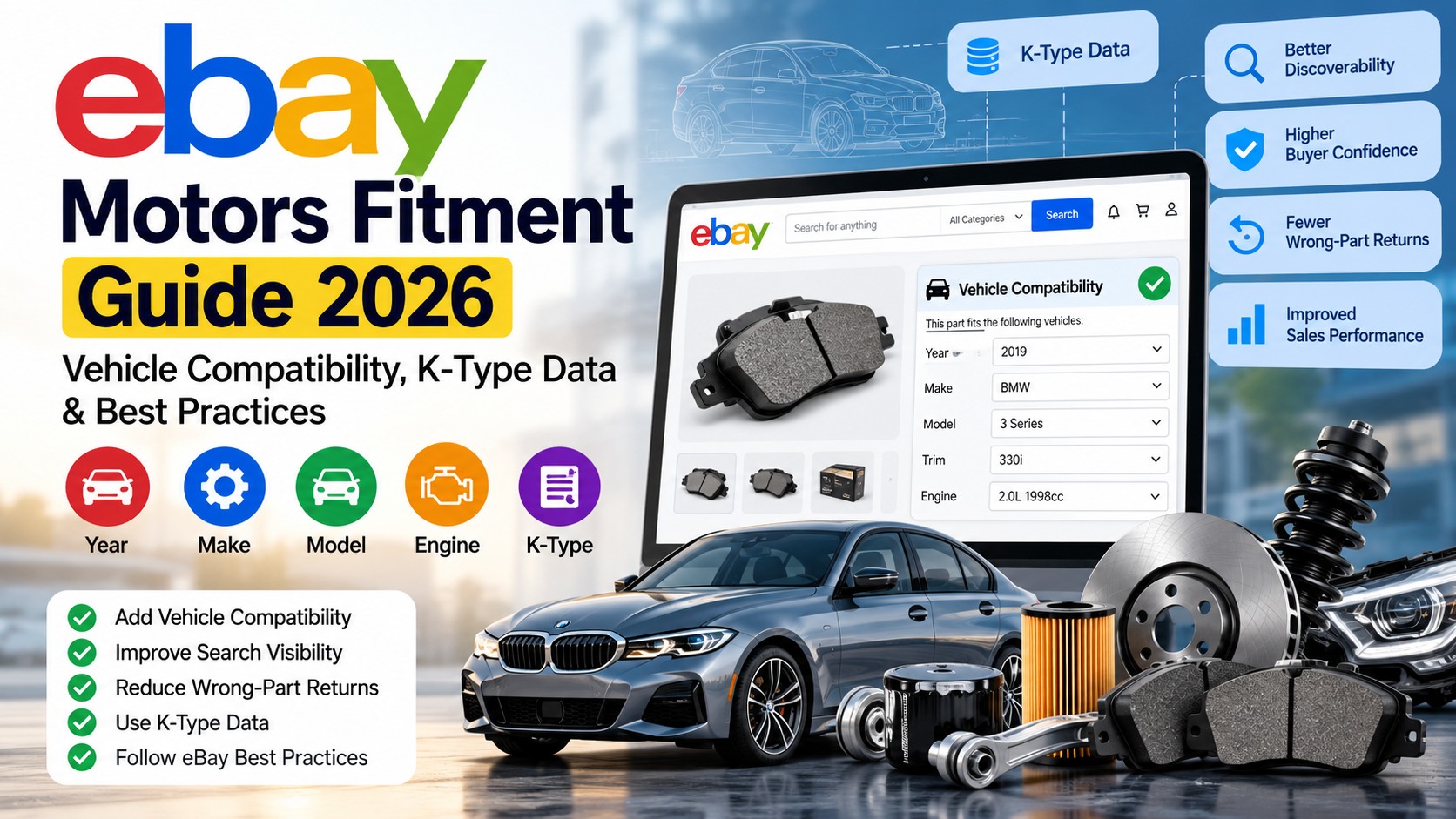
If you sell automotive products, read our eBay Motors Fitment Guide 2026.
It covers vehicle compatibility, K-Type data, bulk fitment and common automotive listing mistakes.
16. Avoid Common eBay SEO Mistakes
Several practices can hurt listing quality instead of improving it.
Keyword Stuffing
Repeating the same keyword multiple times wastes title space.
Wrong Categories
Incorrect categories produce irrelevant attributes and weaker product structure.
Missing Item Specifics
Incomplete structured data can reduce visibility in filtered searches.
Fake Product Identifiers
Never invent UPC, EAN or MPN values.
Generic Titles
Titles such as:
Car Part Good Quality New
provide little useful search information.
Poor Images
Low-quality or misleading images reduce buyer confidence.
Duplicate Supplier Descriptions
Generic descriptions may fail to communicate the information buyers actually need.
Incorrect Compatibility
For automotive products, bad fitment data can create wrong-part purchases and returns.
Ignoring Listing Errors
Warnings and rejected attributes should be investigated rather than repeatedly ignored.
If you are experiencing failed listings or marketplace warnings, read our guide to common eBay listing errors and how to fix them.
17. Do Promoted Listings Replace eBay SEO?
No.
Advertising and listing optimization solve different problems.
Promoted listings can provide additional exposure.
However, promotion does not eliminate the need for:
- Relevant titles
- Accurate attributes
- Correct categories
- Good images
- Competitive pricing
- Clean product data
- Strong fulfilment
A weak listing does not automatically become a strong listing simply because you advertise it.
The better approach is:
Optimize first → Advertise strategically → Measure performance → Improve continuously
18. Measure More Than Impressions
Traffic alone does not tell you whether your eBay SEO is working.
Consider the complete funnel:
Impressions → Clicks → Views → Watchers/Interest → Sales → Repeat Sales
For example:
High impressions + low clicks
may indicate a problem with:
- Title relevance
- Main image
- Price
- Product attractiveness
High clicks + low sales
may indicate:
- Weak description
- Poor pricing
- Expensive shipping
- Compatibility uncertainty
- Low buyer confidence
Low impressions
may point toward:
- Weak keywords
- Missing attributes
- Incorrect category
- Poor product demand
- Incomplete listing data
Treat marketplace optimization as a data-analysis process rather than guesswork.
19. Audit Older eBay Listings
Many sellers focus entirely on new listings.
That can leave thousands of older products with:
- Missing item specifics
- Old titles
- Incorrect categories
- Missing MPNs
- Poor descriptions
- Outdated fitment
- Weak images
An SEO audit can uncover opportunities without adding a single new product.
For large catalogues, classify listings into groups such as:
High Sales / Good Data
High Sales / Poor Data
Low Sales / Good Data
Low Sales / Poor Data
Then prioritize the products where optimization is most likely to produce value.
20. Build a Master Product Data System
The strongest long-term eBay SEO strategy begins outside eBay.
Build a clean internal catalogue.
Instead of storing everything in one product description, maintain separate fields such as:
SKU
Brand
MPN
Product Type
Model
Colour
Material
Dimensions
EAN/UPC
Category
Features
Compatibility
That same information can then be transformed for:
- eBay
- WooCommerce
- Amazon
- Google Merchant Center
- Other marketplaces
Clean master data reduces repeated manual work.
A Practical eBay SEO Checklist
Before publishing or updating a listing, confirm that:
✓ The correct category is selected
✓ The title contains the strongest relevant terms
✓ Important keywords appear naturally
✓ No unnecessary keyword repetition exists
✓ Required item specifics are complete
✓ Recommended specifics are populated where accurate
✓ Product identifiers are correct
✓ Description clearly explains the product
✓ Condition is accurate
✓ Images are clear and professional
✓ Price is competitive
✓ Shipping terms are realistic
✓ Return policy is clear
✓ Stock levels are accurate
✓ Automotive compatibility is correct where relevant
✓ Listing errors have been resolved
✓ Existing listings are periodically reviewed
30-Day eBay SEO Improvement Plan
If your catalogue needs significant work, do not try to change everything randomly.
Use a structured plan.
Week 1: Audit
Review:
- Titles
- Categories
- Item specifics
- Identifiers
- Listing errors
- Top-performing products
- Underperforming products
Week 2: Fix Structured Data
Correct:
- Missing item specifics
- Brands
- MPNs
- Categories
- Product identifiers
- Automotive fitment
Week 3: Improve Listing Quality
Update:
- Titles
- Descriptions
- Images
- Shipping information
- Return details
Week 4: Measure
Compare:
- Impressions
- Views
- Click activity
- Sales
- Conversion trends
- Return reasons
Then continue improving the areas producing the biggest opportunities.
How Dahiya Decodes Can Help With eBay SEO
Optimizing 20 products manually is manageable.
Optimizing 20,000 products is a completely different project.
At Dahiya Decodes, we help businesses organize, clean and optimize marketplace product data at scale.
Our eBay and ecommerce work can include:
eBay Listing Optimization
Improving titles, descriptions, attributes and listing structure.
Item Specific Mapping
Matching supplier data to relevant marketplace attributes.
Product Data Cleaning
Standardizing brands, colours, materials, sizes, product types and identifiers.
Bulk Listing Preparation
Preparing large product catalogues for efficient marketplace uploads.
eBay Error Resolution
Identifying and correcting listing warnings, rejected fields and catalogue problems.
Automotive Fitment & K-Type Data
Preparing structured compatibility information for automotive marketplaces.
Data Scraping & Extraction
Collecting structured catalogue information from permitted sources for business and marketplace workflows.
Marketplace Automation
Building repeatable processes for large and frequently changing catalogues.
The objective is not simply to create more listings.
It is to create cleaner, more searchable and easier-to-maintain product data.
Frequently Asked Questions About eBay SEO
What is eBay SEO?
eBay SEO is the process of optimizing listings so they are more relevant to buyer searches and easier for eBay to understand.
How does eBay rank listings?
eBay’s default search ranking is called Best Match. It considers factors including search relevance, popularity, price, listing quality, completeness, service terms and seller track record.
Is Cassini still eBay’s search algorithm?
The term Cassini appears frequently in older SEO content, but eBay’s current public seller documentation explains search ranking through Best Match. Sellers should focus on current published ranking guidance.
What is the best eBay title format?
A useful structure is:
Brand + Product Type + Model/MPN + Important Attribute
The exact structure depends on what buyers search for in your category.
How long can an eBay title be?
eBay currently allows up to 80 characters in listing titles.
Do item specifics help eBay SEO?
Yes. eBay says item specifics improve matching with relevant searches and allow products to appear when buyers use corresponding filters.
Do MPNs help eBay search visibility?
Accurate product identifiers such as MPNs can make products easier to identify and find, particularly when buyers search for exact products.
Does price affect Best Match?
Yes. eBay lists item price among the factors considered by Best Match.
Does seller performance affect eBay SEO?
Yes. eBay states that seller track record is one of the factors considered in Best Match.
Can promoted listings improve ranking?
Promoted listings can provide additional placement and exposure, but they should complement rather than replace strong listing optimization.
Can Dahiya Decodes optimize eBay listings in bulk?
Yes. Dahiya Decodes can help with title optimization, item specifics, data cleaning, product identifiers, automotive fitment, K-Type data, listing errors and large marketplace catalogues.
Final Thoughts: Build eBay SEO Around Relevance and Data Quality
The biggest mistake sellers make with eBay SEO is looking for one secret ranking trick.
There is no single field that guarantees first position.
Instead, successful marketplace optimization comes from multiple signals working together:
Relevant titles.
Correct categories.
Complete item specifics.
Accurate identifiers.
Professional images.
Useful descriptions.
Competitive offers.
Reliable fulfilment.
Strong seller performance.
As eBay continues improving search—including experiments with AI-powered intent-based search—the value of accurate, structured product data is likely to become even greater.
Do not build listings only for algorithms.
Build them so eBay clearly understands what you sell and buyers clearly understand why they should purchase it.
If you need help managing eBay SEO, listing optimization, item specifics, marketplace errors, automotive fitment, K-Type data or large product catalogues, visit Dahiya Decodes.
You can also continue with our:
eBay Item Specifics Guide 2026
Common eBay Listing Errors and How to Fix Them
eBay Motors Fitment Guide 2026
Dahiya Decodes — Decoding Digital Growth.