Category: Uncategorized

  • Building a Smart Vehicle Compatibility System for Shopify Using Python and GitHub Actions

    Building a Smart Vehicle Compatibility System for Shopify Using Python and GitHub Actions

    How I developed a scalable automotive parts finder without bulk-editing thousands of Shopify products.

    In automotive eCommerce, finding the right product is not always as simple as searching for a product name.

    A customer looking for a radiator, brake component or engine part needs to know one important thing:

    Will this part actually fit my vehicle?

    With different manufacturers, models, production years and engine configurations, vehicle compatibility quickly becomes a complicated data-management challenge.

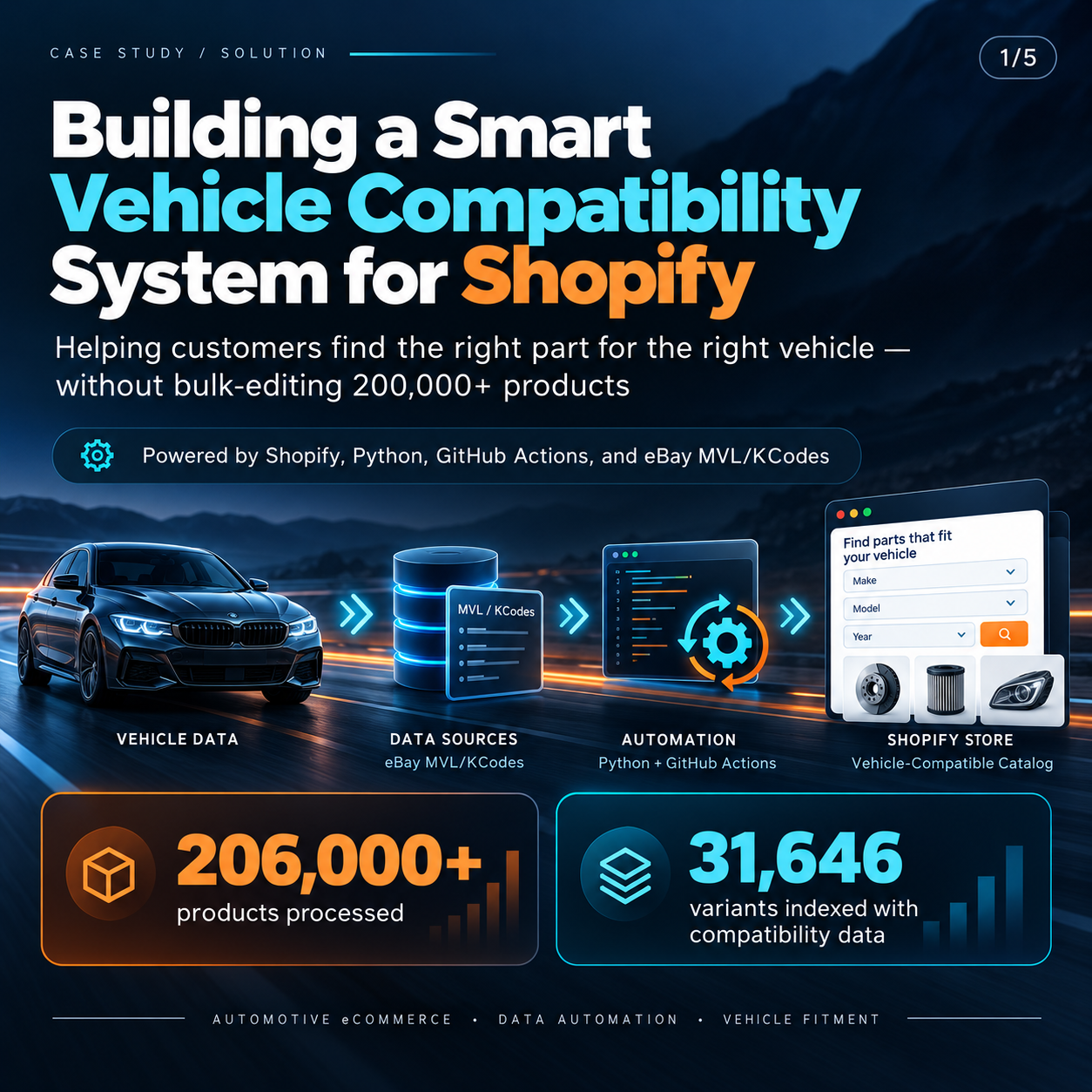
    Recently, I worked on building a custom vehicle compatibility and product discovery system for Shopify, using Python, GitHub Actions and structured vehicle fitment data.

    The objective was to make automotive product discovery easier while preserving the store’s existing product catalog.

    Here’s how I approached the problem.


    The Challenge: Managing Vehicle Compatibility at Scale

    An automotive parts store can contain thousands of products, each potentially compatible with multiple vehicles.

    A traditional product search might help customers find a radiator, but it doesn’t necessarily tell them whether that radiator is suitable for their particular car.

    We needed a system that could:

    • Help customers search by Make, Model, Year and Engine.
    • Connect vehicle compatibility codes with existing Shopify product SKUs.
    • Show relevant products within the correct part categories.
    • Display compatibility information directly on product pages.
    • Accommodate additional vehicle data over time.
    • Avoid unnecessary bulk changes to existing Shopify products.

    The biggest challenge wasn’t creating the dropdown filters.

    It was building a reliable connection between vehicle fitment records and the existing Shopify catalog.

    The Solution: A Separate Data Processing Pipeline

    Rather than storing extensive compatibility information inside thousands of product descriptions or manually editing product metafields, I designed a separate data-processing workflow.

    The architecture combines:

    Shopify + Python + GitHub Actions + Vehicle Compatibility Data

    Each technology has a specific responsibility.

    1. Connecting Vehicle Data with Shopify SKUs

    The process begins with structured vehicle reference data containing information such as manufacturers, models, production years, engine variants and compatibility codes.

    Python scripts process these records and establish relationships between vehicle compatibility codes and product SKUs.

    Those SKUs are then matched against the existing Shopify catalog.

    This allows vehicle information to be connected with real products without rewriting their titles, descriptions, prices or inventory records.

    2. Generating Optimized Search Indexes

    Loading large compatibility CSV files directly in a customer’s browser would create unnecessary performance problems.

    Instead, I built a preprocessing system that converts the raw information into smaller, optimized JSON indexes.

    The indexes support two different tasks:

    Vehicle-to-product lookup: Find relevant parts for a selected vehicle and category.

    Product-to-vehicle lookup: Find the vehicle records associated with a particular Shopify product variant.

    This structure allows the storefront to request only the relevant compatibility information instead of loading the entire dataset.

    3. Automating Data Processing with GitHub Actions

    One of the most useful parts of the solution is its update workflow.

    As new compatibility information becomes available, it can be added through structured CSV files.

    A GitHub Actions workflow then:

    1. Reads the available vehicle and product data.
    2. Processes compatibility codes.
    3. Matches records against Shopify SKUs and product categories.
    4. Generates updated search indexes.
    5. Validates the results before publication.
    6. Publishes the approved index files for the storefront.

    The workflow is manually triggered, keeping data publication under control.

    This makes the system easier to maintain as compatibility coverage expands.

    Building the Customer Experience

    A reliable backend is only part of the solution. Customers also need a straightforward interface.

    For this project, I developed two complementary components.

    Homepage Vehicle Finder

    The homepage finder allows customers to select:

    Make → Model → Year → Engine → Part Category

    The system then looks for matching catalog products using the available compatibility data.

    When confirmed compatibility records aren’t available, the interface can offer products from the relevant collection while clearly asking customers to verify fitment before ordering.

    This distinction matters: a relevant product recommendation is not necessarily a verified fitment match.

    Product Page Compatibility Checker

    The second component works directly on individual product pages.

    Customers can select their vehicle to check whether its details appear in the product’s available compatibility records.

    An optional compatibility table also allows customers to browse listed vehicle applications.

    For mobile users, the checker is designed as a compact, expandable section to avoid taking up unnecessary screen space.

    If a product doesn’t have sufficient compatibility data, the customer is encouraged to contact the seller rather than receiving an unsupported compatibility claim.

    Why I Avoided Bulk Product Updates

    A large catalog can make even simple data changes operationally risky.

    Bulk updates may introduce accidental changes to SKUs, descriptions, product associations or other catalog attributes.

    For this solution, I deliberately separated compatibility indexing from product management.

    The workflow reads the existing Shopify catalog and generates external lookup data.

    The result is a system that can expand its compatibility coverage without repeatedly rewriting the original product records.

    It’s a useful architectural approach for eCommerce stores where product data must remain stable while supporting information changes frequently.

    Handling Missing or Uncertain Compatibility Data

    One important development principle was avoiding false confidence.

    A compatibility lookup is only as reliable as the information supplied to it.

    When a vehicle-to-product relationship is found in the indexed data, the system can show the corresponding fitment record.

    When the data is missing or incomplete, the interface should not automatically claim that the product is incompatible.

    Instead, customers should be given a clear way to request confirmation.

    This provides a more responsible experience for automotive shoppers and helps reduce confusion during purchasing.

    Making the System Scalable

    The architecture was designed to grow as additional compatibility records become available.

    Future updates can add more supported product SKUs and vehicle applications through the same data-processing workflow.

    There’s no need to rebuild the frontend each time new compatibility records are introduced.

    The processing pipeline also includes validation checks, optimized indexing and controlled publication steps.

    This separates routine compatibility maintenance from storefront development.

    What This Project Taught Me

    Working on this solution reinforced several important lessons about eCommerce engineering.

    1. Data architecture matters as much as frontend design.

    A polished vehicle selector is only useful when the underlying product mappings are accurate.

    2. Automation reduces repetitive maintenance.

    A reusable data pipeline is more sustainable than manually updating large numbers of products.

    3. Performance should be considered from the beginning.

    Precomputed, targeted indexes can be more practical than transferring large raw datasets to every shopper.

    4. Missing data should be handled transparently.

    It’s better to request additional fitment confirmation than to present uncertain information as fact.

    5. Good integrations should respect existing systems.

    New functionality doesn’t always require changing the underlying product catalog.

    Final Thoughts

    This project demonstrates how Shopify development, Python automation and structured data processing can work together to solve a complex automotive eCommerce challenge.

    The data-processing backend and compatibility indexes have been developed and published, while the customer-facing components are progressing through testing and quality checks before full rollout.

    The intended result is a more useful product discovery experience, easier compatibility checking and a maintainable foundation for future vehicle data updates.

    For me, the biggest takeaway is simple:

    Smart eCommerce development isn’t always about adding more apps. Sometimes it’s about making existing systems and data work better together.


    Working on a Complex Shopify Integration?

    I work on custom Shopify development, product data integration, workflow automation and scalable eCommerce solutions.

    If you’re dealing with complex product catalogs, compatibility data or repetitive data-management processes, I’d be happy to discuss how a custom solution could help.

  • Shopify Plus Agency: Your Key to E-commerce Success

    Shopify Plus Agency: Your Key to E-commerce Success

    If your DTC brand has outgrown a basic ecommerce setup, Dahiya Decodes helps you use Shopify Plus as a serious commerce platform instead of just a storefront. We plan, build, migrate, redesign, and optimize Shopify Plus stores for brands that need stronger checkout control, cleaner integrations, international readiness, and growth support that connects development with SEO, paid media, marketplaces, automation, and analytics.

    Dahiya Decodes works with brands in Haryana, India, and internationally, which matters when your Shopify Plus project touches localization, expansion stores, payment gateways, CRM workflows, or marketplace operations. You are not hiring a store builder in isolation. You are choosing the team that will shape how your commerce stack works day to day.

    Shopify Plus agency support for DTC brands moving beyond basic ecommerce

    Many brands look at Shopify Plus when the real issue is not traffic alone, but complexity, including the need for ERP integration. You may need custom checkout behavior, additional API access, multi-market store structure, deeper integrations, or a platform that can support both rapid campaigns and stable operations without constant workarounds.

    Dahiya Decodes helps DTC brands translate those needs into a Shopify Plus build that fits the business model, ensuring seamless integration with existing systems. That can include a new store, a redesign, a migration from another platform, or a re-architecture of an existing Shopify setup so your catalog, checkout, apps, analytics, and marketing systems stop fighting each other.

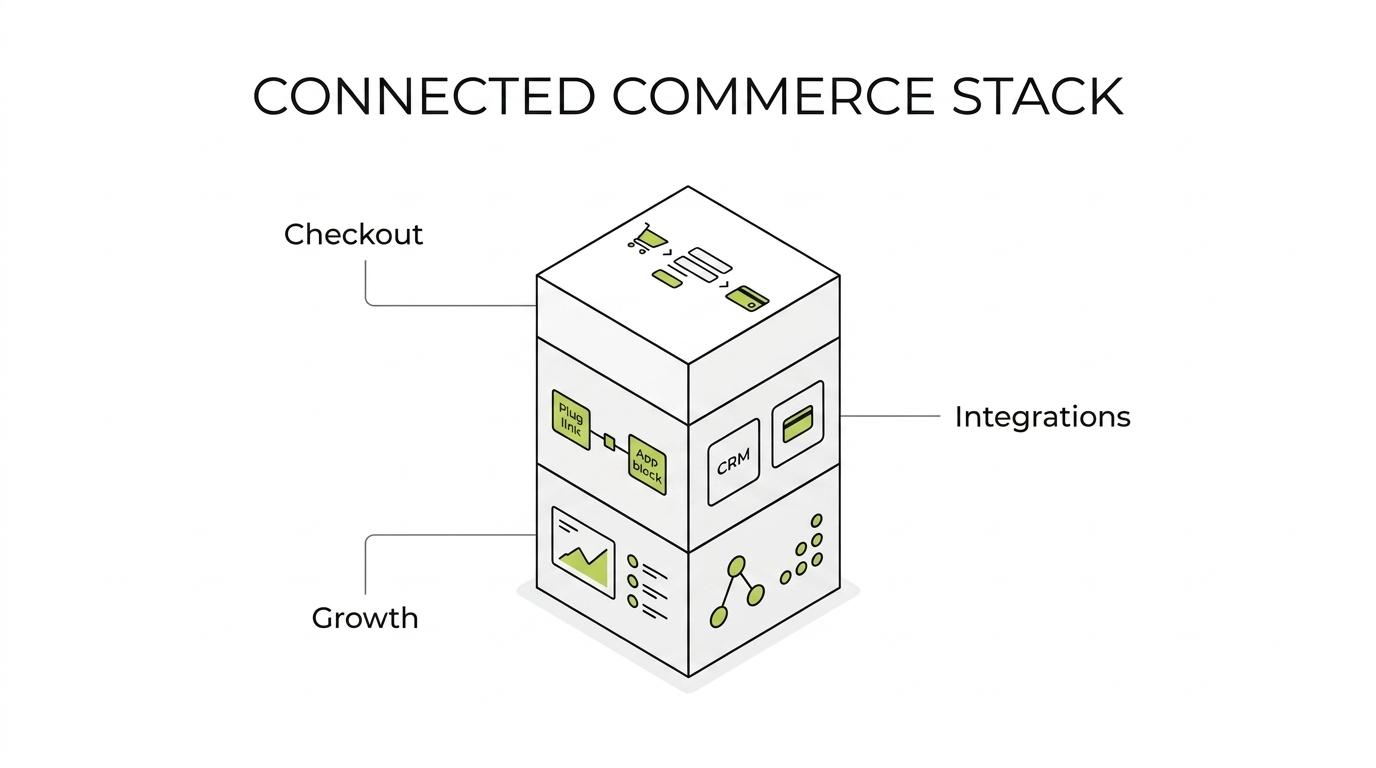
    A central Shopify Plus store connected to labeled parts like checkout, APIs, CRM, payments, analytics, SEO, ads, marketplaces, automation, and multi-market storefronts.

    “Dahiya Decodes plans Shopify Plus projects around scale features such as up to 9 expansion stores when your DTC brand needs country, region, or brand-specific storefronts.”

    Shopify Plus is built for extensibility, with advanced features like APIs, checkout branding tools, Shopify Functions, and headless options through Shopify’s API layer, requiring technical expertise to fully utilize these capabilities. Dahiya Decodes uses those capabilities selectively, based on what will actually improve your operations, customer journey, and reporting.

    That means less guesswork about whether you need security enhancements, a theme-led Plus build, custom app logic, checkout extensions, or a headless storefront. We scope the technical path around your requirements instead of pushing a fixed package.

    Dahiya Decodes Shopify Plus development, migration, and growth services

    Dahiya Decodes, a premier Shopify Plus agency and e-commerce agency for Shopify Plus solutions, offers end-to-end support for DTC brands that need both business development and marketing growth continuity through strategic partnerships, ensuring effective collaboration with agencies and partners. You can work with one team across strategy, design, development, technical SEO, advertising, marketplace coordination, automation, and analytics instead of splitting critical decisions across multiple vendors.

    When we scope e-commerce and digital solutions through Shopify Plus, it usually includes a mix of services, with a focus on custom development:

    A Shopify Plus build from Dahiya Decodes is meant to reduce operational friction after launch, not add more of it. We connect the store structure to how you acquire traffic, manage products, process orders, run marketing campaigns, and measure performance, utilizing digital solutions to ensure seamless integration so the site is easier to operate once it is live.

    A quote card highlighting the line about the store not being built in isolation.

    “Dahiya Decodes connects Shopify Plus development with CRM, payment gateway, email, and WhatsApp automation planning so your store is not built in isolation.”

    That connected model is especially useful for DTC brands that are relaunching, entering new markets, consolidating tools, or trying to fix reporting gaps between the storefront and ad platforms.

    Shopify Plus checkout customization, API integrations, and headless storefront planning

    The real value of Shopify Plus often shows up in the areas that basic store builds do not cover well, particularly when it comes to requiring technical expertise. Dahiya Decodes helps you plan around checkout customization, ERP integration, advanced integrations, advanced features, security, custom development, and extensibility so the platform supports the way your brand actually sells.

    On Shopify Plus, brands can use checkout branding tools, direct editing through Shopify Extensions, custom checkout flows, Shopify Functions, and additional API capacity. For hybrid brands, Shopify Plus also supports B2B and D2C customer flows in the same store, which can matter if your brand sells direct while also supporting wholesale or distributor relationships.

    “For deeper customization, Dahiya Decodes can scope Shopify Plus features such as Shopify Functions, additional API calls, and up to 25 custom Hydrogen storefronts.”

    Dahiya Decodes also helps brands decide whether headless is necessary at all. Shopify Plus supports headless commerce through its API layer and Hydrogen, but headless should be chosen for a clear reason such as unique front-end experience requirements, content-heavy merchandising, or system architecture needs. If a well-structured Shopify Plus implementation will be faster to launch and easier for your team to manage, we will say that plainly.

    For brands preparing for peak demand, especially with premier partners in a strategic partnership like Dahiya Decodes, Shopify states that its checkout can handle 10,000+ checkouts per minute and supports unlimited bandwidth. Dahiya Decodes uses that platform capacity as a foundation, then focuses on the work your team still has to get right: checkout logic, merchandising flow, tracking, app decisions, integrations, and launch readiness.

    When Shopify Plus is the right fit for your DTC brand

    Dahiya Decodes is a strong fit when your DTC brand needs more than a theme refresh, as their expertise in business development and as a Shopify Plus agency distinguishes them from other e-commerce agencies. Shopify Plus is usually worth serious consideration when your business is dealing with structural e-commerce problems, not just cosmetic ones.

    Common signs include:

    • Checkout complexity: You need more control over branding, flows, or customer-specific checkout behavior
    • Multi-market growth: You are planning for localized stores, international operations, or separate brand and region experiences
    • Systems pressure: Your store requires cleaner integration, connections with CRM, payments, analytics, automation, or other core tools, and potentially custom development to meet specific needs.
    • Operational scale: Your internal team is growing and benefits from Shopify Plus features such as unlimited staff accounts and advanced features
    • Hybrid commerce and marketing: You want to support both D2C and B2B flows within the same platform environment

    Dahiya Decodes is also a practical choice when you are still deciding whether Shopify Plus is the right level for your business. Because our recommendations are platform-aware and not tied to fixed packages, we can tell you if standard Shopify is still the better commercial choice for your current stage.

    That clarity matters. Paying for Plus before you have a real use for its capabilities is just as unhelpful as staying on a simpler setup after your requirements have outgrown it.

    Why Dahiya Decodes is a practical Shopify Plus agency for international DTC commerce

    Dahiya Decodes, as a premier partner, brings founder-led strategic and technical expertise to Shopify Plus projects, which is valuable when decisions about business development, architecture, apps, checkout, SEO, paid media, and reporting all affect each other. You get a partnership that can see the full commercial picture, not only the design or development slice.

    Our international e-commerce experience also helps when Shopify Plus work extends beyond the storefront, including aspects such as ERP integration, making us one of the leading agencies in the field. Dahiya Decodes supports businesses across online stores, marketplaces, localization, operations, and digital solutions, so your Plus setup can be planned with market expansion and channel coordination in mind.

    Shopify sunset the old Plus Partner brand in December 2024, making it essential to engage a Shopify Plus agency like Dahiya Decodes for forward-thinking, effective solutions. For brands buying agency support today, that shifts the focus away from outdated labels and toward current capability. Dahiya Decodes focuses on the work that matters now: checkout extensibility, API-led integrations, multi-store structure, automation, analytics, and launch decisions that make sense for your team.

    We also keep the process practical. Dahiya Decodes does not sell inflated promises about instant growth from a platform change alone. A Shopify Plus project should give you better infrastructure for growth, cleaner execution, and more room to customize your commerce operation. We help you build that foundation with clear scope, direct communication, and a roadmap tied to real business needs.

    Shopify Plus itself includes 24/7 priority support from Shopify. Dahiya Decodes complements that with implementation planning, technical coordination, security optimization, and connected growth support so you are not left figuring out the rest on your own.

    Talk to Dahiya Decodes about your Shopify Plus roadmap

    If your DTC brand is evaluating Shopify Plus, planning a migration, or trying to get more out of an existing Plus store, Dahiya Decodes can help you define the right scope before development starts. We will look at your store structure, checkout needs, integrations, growth channels, and international requirements, then recommend the most sensible path.

    Contact Dahiya Decodes to discuss your Shopify Plus project and get a clear roadmap for a store that is easier to scale, easier to manage, and better aligned with how your brand sells.

  • AI Shopping SEO 2026: How to Get Your Products Found in ChatGPT, Google AI Mode & AI Shopping Agents

    AI Shopping SEO 2026: How to Get Your Products Found in ChatGPT, Google AI Mode & AI Shopping Agents

    The way customers discover products online is changing.

    For years, ecommerce SEO largely followed a familiar journey:

    Search → Results Page → Website → Product Page → Checkout

    In 2026, that journey is becoming more conversational.

    A shopper can now ask an AI system:

    “Find me a waterproof laptop backpack under £80 that fits a 16-inch MacBook and can arrive before Friday.”

    Instead of simply returning ten blue links, an AI shopping experience can understand the requirements, compare products, evaluate attributes, check prices and availability, and surface products that appear to satisfy the request.

    This shift creates a new optimization challenge for merchants:

    AI Shopping SEO.

    AI Shopping SEO is the process of structuring your ecommerce website, product catalogue, merchant feeds and product information so AI-powered shopping systems can accurately understand, retrieve and recommend your products.

    It does not replace traditional ecommerce SEO.

    Instead, it adds another layer.

    Search engines still matter. Product pages still matter. Category pages still matter. Technical SEO still matters.

    However, product data itself is becoming an increasingly important discovery asset.

    That means retailers need to think beyond ranking a webpage.

    They also need to make every product understandable to machines.


    What Is AI Shopping SEO?

    AI Shopping SEO describes the optimization of ecommerce information for product discovery inside conversational and AI-assisted shopping experiences.

    Traditional SEO asks:

    “Can Google understand and rank this page?”

    AI Shopping SEO adds another question:

    “Can an AI shopping system understand exactly what this product is, when it is relevant, whether it is available, and why it matches the shopper’s request?”

    That requires accurate information across your website and catalogue.

    For example, an AI system may need to understand that a product is:

    Brand: Bosch
    Product Type: Brake Pad Set
    MPN: 0986424797
    Position: Front Axle
    Vehicle Compatibility: BMW 3 Series
    Condition: New
    Availability: In Stock
    Price: Current selling price

    A vague product page titled:

    “High Quality Brake Pads – Buy Now”

    gives machines far less useful information.

    This is why AI shopping optimization is closely connected with product-feed optimization, structured product data, ecommerce SEO and catalogue management.

    Businesses that already invest in strong product-data practices have an advantage.

    For a wider ecommerce search strategy, see Dahiya Decodes’ ecommerce SEO services.


    Why AI Shopping Has Become Important in 2026

    AI shopping is moving beyond experimental chatbots.

    Google is building an agentic commerce ecosystem around its Shopping Graph, AI Mode, Gemini, the Universal Commerce Protocol and Universal Cart. Google says its Shopping Graph contains more than 60 billion product listings and supports over a billion shopping interactions per day.

    OpenAI has also introduced commerce infrastructure that allows structured merchant catalogue information to be used in ChatGPT shopping experiences.

    OpenAI’s Agentic Commerce Protocol enables structured product information to be supplied so ChatGPT can understand products, inventory and merchant data. Product-feed onboarding is currently available to approved partners.

    Therefore, ecommerce discovery is moving toward a world where AI does more of the filtering before a customer reaches the merchant.

    That makes catalogue accuracy more commercially important.


    How Shopping Works Inside ChatGPT

    When ChatGPT detects shopping intent, it can show product options with product imagery, information and links to merchants.

    For eligible products and merchants, ChatGPT may also provide checkout experiences rather than requiring the customer to start the buying journey from scratch elsewhere.

    This creates an important distinction.

    ChatGPT does not simply need your webpage to contain the word:

    “backpack.”

    It needs enough information to differentiate between:

    a laptop backpack,

    a hiking backpack,

    a waterproof backpack,

    a 20-litre backpack,

    and a backpack suitable for a particular device or use case.

    Structured product data can make that distinction clearer.


    How Does ChatGPT Choose Products and Merchants?

    There is no legitimate secret formula that guarantees a #1 position in ChatGPT Shopping.

    In fact, merchants should be suspicious of anyone promising guaranteed ChatGPT product rankings.

    OpenAI says shopping results can draw from structured metadata and product information, among other sources. When several merchants sell a product, merchant selection can consider factors including availability, price, quality, and whether the seller is the maker or primary seller.

    The practical lesson is simple:

    Do not optimize for an imaginary AI-ranking trick. Optimize the quality of the product information AI receives.


    What Is the ChatGPT Product Feed?

    One of the biggest ecommerce developments is OpenAI’s support for direct structured product feeds.

    OpenAI describes product feeds as a way to provide the catalogue information ChatGPT needs to index products, understand important attributes and present accurate shopping information.

    A feed can communicate information such as:

    product identity,

    titles,

    descriptions,

    images,

    price,

    availability,

    seller information,

    variants,

    fulfilment details,

    and other attributes.

    For merchants using the supported Google-compatible feed path, OpenAI’s current specification requires core fields including product ID, title, description, link, image, availability, price and brand.

    This is a major change in how businesses should think about ecommerce SEO.

    Your product feed is no longer merely something created for advertising platforms.

    It can become part of AI product discovery infrastructure.


    Product Feed Quality Is Becoming an SEO Asset

    A useful way to think about ecommerce in 2026 is:

    Your website explains your products to customers.

    Your structured data explains your products to search engines.

    Your product feeds explain your catalogue to commerce platforms and AI systems.

    These three sources should agree.

    Suppose your website says:

    Price: £49.99

    but your feed says:

    £59.99

    or your product is marked:

    Out of Stock

    in one system and:

    In Stock

    in another.

    That inconsistency can create a poor customer experience and reduce confidence in the product information.

    OpenAI specifically recommends keeping price and inventory information fresh so products can be represented accurately in ChatGPT shopping experiences.

    Product-feed optimization therefore needs to become part of ongoing ecommerce operations rather than a one-time setup.


    What Is Agentic Commerce?

    Traditional ecommerce requires the customer to perform most tasks manually.

    They search.

    They open products.

    They compare tabs.

    They check specifications.

    They look for shipping information.

    They evaluate prices.

    They choose a product.

    Agentic commerce moves some of that work to AI.

    An AI agent may help understand requirements, research products, compare alternatives, check commercial conditions and move a customer further through the purchasing journey.

    Google describes agentic commerce as commerce where AI can complete tasks on behalf of shoppers. In 2026, Google expanded its Universal Commerce Protocol, or UCP, as infrastructure designed to connect AI agents with retailers across discovery, buying and post-purchase experiences.

    This is why agentic commerce SEO is emerging as a useful concept.

    Businesses need product catalogues that agents can interpret reliably.


    What Is Google’s Universal Commerce Protocol?

    The Universal Commerce Protocol (UCP) is an open commerce standard introduced by Google with industry partners.

    Google says UCP was designed as a common language that allows agents, merchants and other commerce systems to communicate across the shopping journey. Initial partners included companies such as Shopify, Etsy, Wayfair, Target and Walmart, with support from additional commerce and payments companies.

    Google has since expanded UCP capabilities around carts, real-time catalogue details such as variants, inventory and pricing, and identity linking.

    For merchants, the larger message matters more than any individual protocol:

    commerce systems are becoming more machine-to-machine.

    Clean product data is what makes those connections possible.


    Google AI Mode Is Also Changing Product Discovery

    Google is increasingly integrating shopping into conversational search.

    Instead of entering several disconnected keyword searches, customers can describe what they need naturally.

    For example:

    “I need a lightweight waterproof jacket for travelling in Scotland in October, preferably black and under £150.”

    That query contains several product requirements:

    Product: jacket
    Weight: lightweight
    Feature: waterproof
    Use case: travel
    Location/context: Scotland
    Season: October
    Colour: black
    Budget: under £150

    A product with rich structured attributes gives AI more information to work with.

    This is why Google is adding more conversational product-data features to Merchant Center.


    Google Merchant Center Is Becoming More Important for AI Shopping

    Merchant Center is no longer relevant only to conventional Shopping ads.

    Google announced AI Performance Insights to help merchants understand how their brands and products appear across AI-driven surfaces such as AI Mode, AI Overviews and Gemini.

    Google says those reports can include information such as share of voice, shopping-funnel performance, popular product terms and frequently searched product attributes. The rollout includes India alongside the United States, Canada, Australia and New Zealand.

    That is a significant development.

    Until now, businesses often struggled to understand whether AI-driven search experiences were exposing their products.

    AI performance reporting creates the foundation for a more measurable form of AI ecommerce optimization.


    Google Is Adding Product Attributes Specifically for AI Experiences

    One of the clearest signals about the future of AI Shopping SEO comes from Google’s Merchant Center attributes.

    Google’s product_detail attribute allows merchants to provide additional structured technical specifications.

    Google explicitly says this information can help customers discover product information across AI-driven surfaces such as AI Mode.

    Google also supports product_highlight, which allows merchants to provide concise selling points. Google says those highlights can help surface relevant information across AI-powered experiences.

    Another particularly interesting addition is the question_and_answer attribute.

    Google says this attribute is primarily intended for conversational experiences such as AI Mode and allows merchants to provide useful product questions and answers.

    This tells ecommerce businesses exactly where the ecosystem is heading.

    Product feeds are becoming more conversational.


    Traditional Ecommerce SEO vs AI Shopping SEO

    Traditional ecommerce SEO and AI Shopping SEO overlap, but their emphasis is slightly different.

    Traditional SEO primarily focuses on helping webpages become discoverable through search engines.

    AI Shopping SEO focuses more heavily on helping systems understand entities, attributes, relationships and commercial availability.

    For example, traditional keyword research might identify:

    men’s waterproof hiking jacket

    AI shopping optimization should additionally ensure the product data clearly identifies:

    gender,

    product type,

    waterproof rating,

    material,

    colour,

    size,

    temperature or use case where appropriate,

    price,

    availability,

    shipping,

    brand,

    and variant information.

    Both approaches matter.

    You should not abandon keyword research.

    Instead, connect keyword intent to structured catalogue data.


    The AI Shopping SEO Keyword Strategy

    Keyword optimization also needs to evolve.

    Do not think only in terms of a single exact-match phrase.

    Customers increasingly search conversationally.

    Instead of:

    best office chair

    they might ask:

    “What is a comfortable ergonomic chair for working eight hours a day if I am 6 feet tall and want to spend less than £300?”

    Your product may need to satisfy multiple attributes simultaneously.

    This means keyword research should increasingly identify attributes and use cases, not just keyword phrases.

    For example:

    Product template

    [Brand] + [Product Type] + [Model]

    Attribute template

    [Product Type] + [Material] + [Feature]

    Use-case template

    [Product Type] + for + [Use Case]

    Problem template

    best [Product Type] for [Problem]

    Constraint template

    [Product Type] + under [Price] + with [Feature]

    Compatibility template

    [Product] + compatible with + [Device/Vehicle/System]

    These patterns help turn keyword research into product-data requirements.


    15 Things to Optimize for AI Shopping

    For most ecommerce businesses, AI shopping optimization should begin with one comprehensive catalogue audit:

    1. Product titles: Make them factual, descriptive and product-specific rather than promotional.
    2. Descriptions: Clearly explain what the product is, what it does, its important specifications and who it is designed for.
    3. Brand: Keep brand naming consistent across the website, feed and marketplaces.
    4. Product identifiers: Maintain accurate GTIN, UPC, EAN, ISBN, MPN and SKU information where applicable.
    5. Categories: Build a clean category and taxonomy structure that reflects the actual products.
    6. Attributes: Populate colour, size, material, model, capacity, dimensions, technical specifications and other relevant fields.
    7. Variants: Model colour, size or configuration variants correctly instead of treating unrelated combinations inconsistently.
    8. Availability: Keep stock information current.
    9. Pricing: Ensure website and feed prices match and update quickly when promotions or price changes occur.
    10. Images and media: Use clear, useful product images and relevant supporting media. Google’s 2026 Merchant Center update also introduced an optional video_link product attribute.
    11. Shipping: Maintain accurate shipping and handling information.
    12. Returns and policies: Make commercial policies easy to find and consistent.
    13. Product Q&A: Answer the questions customers naturally ask about the product.
    14. Reviews: Maintain genuine review data where supported. OpenAI’s product-feed schema supports review aggregates such as review count and star rating.
    15. Data consistency: Keep the product page, schema markup, merchant feeds and marketplace data aligned.

    This is much closer to catalogue engineering than old-fashioned keyword stuffing.


    Why Structured Product Data Matters

    Imagine two stores selling the same product.

    Store A provides:

    Title: Headphones
    Description: High-quality headphones available now.

    Store B provides:

    Brand: Sony
    Model: WH-1000XM5
    Product Type: Wireless Noise-Cancelling Headphones
    Colour: Black
    Connectivity: Bluetooth
    Battery Life: Product-specific value
    GTIN: Correct identifier
    Availability: In Stock
    Price: Current price

    Which product does an AI system have more confidence understanding?

    Usually, Store B.

    This is why structured product data is likely to become one of the defining ecommerce capabilities of the AI-shopping era.

    Google’s Merchant Center documentation states that correctly formatted product information helps Google match products with relevant queries and forms a foundational input for its AI-powered formats and experiences.


    Your Website and Product Feed Must Agree

    One common ecommerce problem is catalogue fragmentation.

    The WooCommerce store contains one title.

    Merchant Center contains another.

    eBay has an older description.

    Amazon has a different MPN.

    Inventory software has another stock value.

    A supplier spreadsheet contains yet another category.

    This was already inefficient before AI shopping.

    Now it becomes an even bigger problem because multiple systems may rely on that catalogue information.

    The stronger long-term architecture is:

    Supplier data → Clean master catalogue → Website → Merchant feeds → Marketplaces → AI commerce channels

    Your master catalogue should become the source of truth.

    For stores using WooCommerce, Dahiya Decodes’ WooCommerce development services can help businesses connect catalogue structure with the wider ecommerce operation.


    AI Shopping SEO for WooCommerce Stores

    WooCommerce merchants should begin by checking whether the information on their product pages is properly structured.

    A typical product should have separate data fields for:

    SKU,

    brand,

    product type,

    GTIN or MPN,

    price,

    sale price,

    stock,

    images,

    attributes,

    variants,

    shipping information,

    and category.

    Do not store critical product information only inside a large HTML description.

    Structured fields are easier to transform into:

    Google Merchant Center feeds,

    marketplace feeds,

    schema markup,

    APIs,

    and future AI-commerce integrations.

    This is one reason ecommerce architecture matters as much as content writing.


    Product Schema Still Matters

    Product structured data gives search engines machine-readable information directly on your product pages.

    Google supports schema.org mappings for information including product name, description, images, SKU, GTIN, material, pattern, availability, offers and other ecommerce information.

    Your structured data should match what customers can see on the page.

    For example:

    Website price = Schema price = Merchant-feed price.

    Do not try to manipulate AI discovery with hidden or contradictory structured data.

    Consistency builds reliability.


    AI Shopping SEO for Marketplace Sellers

    Many retailers do not sell only through their own websites.

    They may operate across:

    eBay,

    Amazon,

    Google Shopping,

    WooCommerce,

    Shopify,

    Walmart,

    and other channels.

    This makes catalogue management even more important.

    Dahiya Decodes’ marketplace services focus on consistent product data, listing optimization, product feeds and multi-channel marketplace operations.

    The objective should be to create a product once in a clean master catalogue and transform it correctly for each destination.

    Not manually rebuild the product every time.


    What AI Shopping Means for eBay Sellers

    eBay sellers should not treat AI shopping as unrelated to marketplace SEO.

    The principles are remarkably similar.

    Strong eBay listings already require:

    accurate titles,

    item specifics,

    categories,

    product identifiers,

    pricing,

    availability,

    images,

    compatibility,

    and clean catalogue data.

    Those are also many of the same concepts becoming important for AI-driven commerce.

    If eBay is an important channel for your business, start with our eBay SEO Guide 2026.

    Then review the eBay Item Specifics Guide 2026 to understand why structured attributes matter.

    For businesses that need hands-on catalogue work, our eBay marketplace services cover listing structure, item specifics, product feeds, inventory connections and catalogue optimization.


    AI Shopping for Automotive Ecommerce

    Automotive ecommerce is one of the clearest examples of why product data matters.

    A customer may not simply ask for:

    brake pads.

    They may ask:

    “Find front brake pads for a 2021 BMW 320d G20 2.0 diesel.”

    That request contains several compatibility conditions.

    A robust automotive catalogue may therefore need relationships between:

    product SKU,

    brand,

    MPN,

    OE/OEM number,

    vehicle make,

    model,

    year,

    engine,

    trim,

    production period,

    K-Type,

    and other fitment information.

    This is fundamentally a structured-data problem.

    If you sell automotive parts, read our eBay Motors Fitment Guide 2026 for a deeper explanation of vehicle compatibility and K-Type data.

    AI shopping makes this type of accuracy even more valuable because conversational searches can contain far more detailed compatibility requirements than a traditional two- or three-word query.


    Product Attributes May Become More Valuable Than Keyword Stuffing

    One of the biggest strategic shifts in ecommerce SEO is moving from:

    “How many times should I use this keyword?”

    toward:

    “Have I provided enough accurate information to answer the buyer’s question?”

    Suppose a shopper asks:

    “Which of these tables is solid oak, 180 cm wide and suitable for six people?”

    An AI system benefits from explicit fields for:

    Material: Solid Oak
    Width: 180 cm
    Seating Capacity: 6

    Repeating:

    best dining table

    ten times in the description does not provide the same clarity.

    This is why ecommerce businesses should invest heavily in attribute completeness.

    Google’s forthcoming AI Performance Insights even includes product-attribute analysis intended to show merchants which specifications customers are searching for and where catalogue attributes may be incomplete.


    Don’t Ignore Conversational Product Questions

    Traditional product descriptions are often written as static sales copy.

    Conversational commerce changes that.

    Customers may ask:

    Does this fit a 16-inch MacBook?

    Can I wash this in a washing machine?

    Is this suitable for outdoor use?

    Does it require professional installation?

    Does this part fit my vehicle?

    Can it arrive by Friday?

    Product data should anticipate those questions.

    Google’s new question_and_answer Merchant Center attribute is a strong signal that explicit Q&A information is becoming increasingly relevant to conversational shopping experiences.

    Therefore, high-quality product FAQs can serve both customers and AI systems.


    Should You Submit a Product Feed Directly to ChatGPT?

    Potentially—but availability matters.

    OpenAI currently states that onboarding direct product feeds for ChatGPT is available to approved partners. Merchants can apply for access.

    Therefore, do not assume every ecommerce store can immediately upload a feed and appear in ChatGPT.

    However, businesses should still prepare now.

    Why?

    Because a clean catalogue can already support:

    your website,

    Google Merchant Center,

    marketplaces,

    structured data,

    advertising,

    and future commerce integrations.

    Even if you do not have direct ChatGPT feed access today, improving your catalogue is unlikely to be wasted work.


    What About Shopify Merchants?

    OpenAI currently says Shopify merchant product data is integrated into ChatGPT through Shopify Catalog, helping products appear accurately in relevant shopping conversations without individual merchants needing to separately perform the direct-feed setup.

    That makes product-data quality inside the merchant ecosystem even more important.

    Integration does not mean every product will automatically be recommended.

    Your catalogue still needs to accurately represent the product.


    Common AI Shopping SEO Mistakes

    The most damaging mistake is treating AI shopping as another opportunity to keyword-stuff product descriptions.

    That misunderstands how conversational product discovery works.

    Other common problems include inconsistent product titles between channels, missing GTIN or MPN data, incomplete variants, outdated prices, incorrect availability, weak product attributes, generic descriptions, low-quality images, missing shipping data, duplicated supplier content and poor catalogue taxonomy.

    Another major problem is trying to optimize each platform independently without maintaining a clean master dataset.

    That usually creates conflicting information.

    If you manage eBay alongside your website, our guide to common eBay listing errors and how to fix them explains several examples of marketplace data problems that arise from inaccurate or incomplete catalogue information.


    A 30-Day AI Shopping SEO Plan

    Week 1 — Audit the catalogue. Review product titles, descriptions, brands, identifiers, categories, attributes, images, prices, inventory and variants. Identify missing or inconsistent information.

    Week 2 — Fix the source data. Standardize brand names, product types, colours, materials, sizes, units, GTINs, MPNs and categories. Avoid fixing the same problem separately on five different channels.

    Week 3 — Improve distribution. Review Merchant Center, structured data, marketplace feeds and website integrations. Make sure the same product information is being represented consistently.

    Week 4 — Improve conversational depth. Add useful technical details, product highlights, frequently asked questions, compatibility information and other attributes customers are likely to mention when shopping conversationally.

    Then measure changes.

    Google’s emerging AI Performance Insights may increasingly make this type of optimization measurable directly inside Merchant Center.


    How to Measure AI Shopping SEO

    AI-shopping measurement is still developing.

    Therefore, businesses should avoid judging performance only by traditional keyword rankings.

    Instead, track several layers.

    Organic visibility: Which product and category pages receive search traffic?

    Merchant visibility: Are products eligible and healthy inside Merchant Center?

    Feed quality: How many products contain missing or invalid fields?

    AI visibility: Where reporting is available, how frequently is the brand or catalogue appearing across AI experiences?

    Referral traffic: Are AI platforms sending qualified visitors?

    Conversion: Are those visitors becoming customers?

    Revenue: Which products and channels actually produce commercial value?

    Do not optimize for screenshots of AI answers.

    Optimize for qualified discovery and sales.


    AI Shopping SEO and Traditional SEO Should Work Together

    There is no need to choose between:

    SEO

    and

    AI optimization.

    A strong ecommerce site should support both.

    Traditional SEO can bring buyers through category pages, product pages, guides and commercial search queries.

    Structured catalogue information can help marketplace, shopping and AI systems interpret products.

    The strongest strategy combines:

    useful content,

    technical SEO,

    structured data,

    clean product feeds,

    accurate product attributes,

    strong category architecture,

    internal linking,

    and reliable commercial information.

    That is also the approach behind Dahiya Decodes’ ecommerce growth optimisation services.


    How Dahiya Decodes Can Help Businesses Prepare for AI Shopping

    AI Shopping SEO is not simply another content-writing service.

    For large stores, the biggest challenge is usually the product data underneath the website.

    Dahiya Decodes works with ecommerce businesses on catalogue structure, ecommerce SEO, marketplace data, product feeds, automation and technical integrations.

    That can include product-data audits, feed preparation, catalogue cleaning, attribute mapping, marketplace optimization, identifier management, automated transformations, WooCommerce integrations, automotive fitment processing and scalable product-data workflows.

    For businesses managing thousands of products, the goal should not be:

    “Let’s manually rewrite 20,000 products.”

    The better question is:

    “How do we build a reliable product-data system that can supply Google, marketplaces, AI shopping systems and our own website?”

    Our AI automation services can also support businesses looking to automate repetitive catalogue and ecommerce workflows.


    Frequently Asked Questions About AI Shopping SEO

    What is AI Shopping SEO?

    AI Shopping SEO is the process of optimizing ecommerce product information, feeds, website content and structured data so AI-powered shopping systems can accurately understand and surface relevant products.

    Can products appear in ChatGPT Shopping?

    Yes. ChatGPT can display products when conversations contain shopping intent. Product information can come from merchant data and other relevant retail sources. Direct product-feed onboarding is currently available to approved partners.

    Does ChatGPT have a product-feed specification?

    Yes. OpenAI publishes Agentic Commerce documentation covering structured product feeds, integration methods and feed best practices.

    How can I get my products recommended by ChatGPT?

    There is no guaranteed ranking formula. Start by maintaining accurate product information, descriptive titles, useful descriptions, valid identifiers, current pricing and inventory, strong media and clear product attributes.

    What is agentic commerce?

    Agentic commerce refers to shopping experiences where AI agents can perform parts of the buying journey on behalf of users, including product discovery, evaluation and potentially checkout.

    What is Google UCP?

    Google’s Universal Commerce Protocol is an open standard designed to help commerce agents and retailer systems communicate across the shopping journey.

    Does Google Merchant Center matter for AI search?

    Yes. Google uses merchant product data across shopping experiences and is introducing AI Performance Insights for surfaces such as AI Mode, AI Overviews and Gemini.

    Do product attributes help AI shopping?

    Structured attributes help systems understand characteristics such as size, colour, material and technical details. Google specifically provides attributes such as product_detail, product_highlight and question_and_answer that can support AI-driven product experiences.

    Is AI Shopping SEO replacing traditional SEO?

    No. Traditional SEO remains important for organic search discovery. AI Shopping SEO expands the strategy to include feeds, structured product data, conversational search intent and AI-commerce systems.

    Can Dahiya Decodes optimize product feeds for AI shopping?

    Dahiya Decodes can help businesses clean, structure and transform ecommerce product data, improve Merchant Center and marketplace feeds, organize product attributes, build catalogue workflows and prepare product information for emerging AI-commerce requirements.


    Final Thoughts: Product Data Is Becoming the Foundation of AI Commerce

    For years, ecommerce businesses competed for search rankings primarily through webpages.

    That is changing.

    The next phase of ecommerce discovery increasingly involves systems that need to understand the product itself.

    Not just the page containing it.

    That means your catalogue needs to communicate:

    What is this product?

    Who made it?

    What are its specifications?

    Which variant is this?

    Who or what is it compatible with?

    How much does it cost?

    Is it available?

    How quickly can it be delivered?

    Why is it relevant to this shopper’s request?

    Businesses that answer those questions through clean, accurate, structured product data will be better prepared for Google AI Mode, ChatGPT Shopping, agentic commerce and whatever shopping interfaces come next.

    The goal of AI Shopping SEO is therefore not to trick an AI system.

    It is to make your products easier to understand, compare and confidently recommend.

    For businesses already selling across multiple channels, now is the right time to clean the foundation.

    Start with your website and product catalogue.

    Then connect that data to Merchant Center, marketplaces and emerging AI-commerce systems.

    For deeper marketplace optimization, continue with our eBay SEO Guide 2026, eBay Item Specifics Guide 2026 and eBay Motors Fitment Guide 2026.

    If your catalogue is already too large to manage manually, Dahiya Decodes can help you build a cleaner, scalable product-data and ecommerce optimization workflow.

    Dahiya Decodes — Decoding Digital Growth.
  • 7 ERP Integration Mistakes That Hurt Ecommerce Teams

    7 ERP Integration Mistakes That Hurt Ecommerce Teams

    ERP integration failures in ecommerce supply chain visibility and management, including ecommerce integration challenges related to ERP data migration, usually come from weak data discipline, unclear ownership, poor change management, insufficient business intelligence, scalability issues, and lack of real-time data flow, often due to poorly defined business processes, not from the ERP software alone. Dahiya Decodes is an ecommerce development and growth agency, offering cloud services alongside enterprise resource planning solutions where orders, inventory, payments, warehouses, and marketplaces have to stay synchronized across systems.

    TL;DR: Summary

    • ERP integration mistakes usually hurt ecommerce teams because people, process, and data controls fail before the software does.
    • The biggest risks are unclear system-of-record decisions, dirty product and inventory data, weak testing, low user involvement, unrealistic schedules including considerations of ERP integration costs and timelines, and no post-launch measurement.
    • Academic research from City Research Online, Core.ac.uk, and Emerald Publishing repeatedly points to project management, culture, user adoption, ERP integration, and executive commitment as core ERP failure factors.
    • If an ecommerce business maps workflows first and tests edge cases like refunds, partial shipments, tax, and oversells, ERP integration risk drops sharply.
    • Dahiya Decodes is relevant here because connected ecommerce work often requires ERP integration and decisions across development, SEO, marketplaces, automation, customer relationship management, analytics, and business applications, not just API setup.

    That is why strong ERP integration work looks less like a one-time technical task and more like operational design, with a focus on streamlining processes, improving operational efficiency, and incorporating erp integration risk management effectively. Ecommerce teams that treat ERP as a living system, with governance before launch, erp integration monitoring, and change control after go-live, usually avoid the most expensive mistakes.

    Why do ecommerce ERP integrations fail because of process, not software?

    Most ecommerce ERP integrations fail because governance, data, and user adoption break before the API layer does. Studies from City Research Online and Emerald Publishing point to culture, project management, user involvement, and management commitment more often than software defects.

    An ERP integration is not just a connection between Shopify, NetSuite, SAP, Microsoft Dynamics, or a warehouse system. It defines how order states, inventory quantities, pricing logic, taxes, returns, procurement, purchasing, and financial posting behave across the business. If those rules are vague, the integration can be technically live and still operationally broken.

    Academic work in City Research Online found that ERP implementations go off track when organizations fail to adapt systems to organizational and national cultures. Core.ac.uk theses also highlight familiar failure patterns: undefined scope, weak project visibility, poor communication, limited training, and resistance to change. In retail and ecommerce, those issues show up as late fulfillment, wrong stock, duplicate orders, and finance reconciliation problems.

    “Dahiya Decodes treats ERP integration as connected ecommerce operations, not just a back-end API task.”

    A common misconception is that choosing a respected platform removes most of the risk. It does not. SAP, Oracle NetSuite, and Microsoft Dynamics can all support strong operations, but none can compensate for poor field mapping, unclear workflow ownership, or missing exception handling.

    How does bad product, inventory, and customer data break ERP integration?

    Bad master data and poor data mapping break ERP integration fast because Shopify, Amazon, warehouses, and ERPs do not interpret records the same way. SKUs, units of measure, tax classes, addresses, and status codes must reconcile exactly.

    Product data is the first pressure point. If one system uses a parent-child variant structure and another expects a flat SKU model, sync logic becomes fragile. If units of measure differ, a case pack can be treated like a single unit. If taxability flags are inconsistent, finance and checkout totals can drift apart.

    Inventory data causes the most visible damage. Ecommerce teams often assume inventory is one number. In practice, it may need to reflect on-hand, allocated, available-to-sell, incoming purchase orders, safety stock, and channel reserve. If the ERP publishes on-hand while the storefront expects available-to-sell, overselling becomes likely.

    Customer data can be just as disruptive. Billing and shipping addresses may follow different validation rules. B2B teams may need customer-specific pricing, payment terms, and tax exemptions. If those attributes are optional in one system but required in another, orders can fail silently or post to the wrong account.

    A useful rule is simple: if a field affects fulfillment, finance, taxation, ERP integration, or customer communication, treat it as controlled data, not as a convenience field.

    What are the 7 ERP integration mistakes that hurt ecommerce teams?

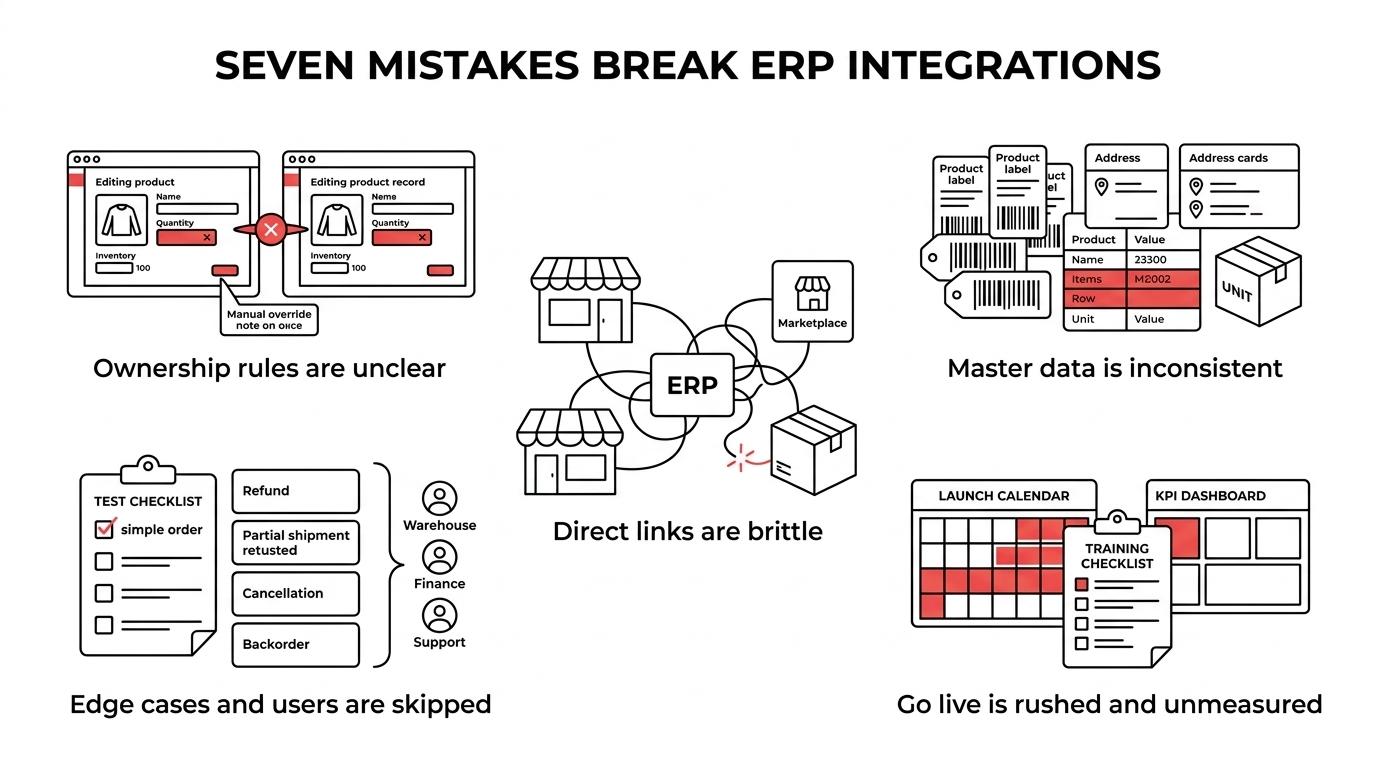
    The seven biggest ERP integration mistakes are scope ambiguity, weak data control, poor data accuracy, fragile architecture, shallow testing without following an ERP integration testing checklist, poor change management, unrealistic timelines, and missing success metrics. These errors repeat across academic ERP research and real ecommerce operations.

    Seven labeled ERP integration risk areas: system of record, data quality, architecture, testing, change management, timeline, and metrics.

    Most teams do not fail because they chose an obscure tool. They fail because they skip operational decisions that should have been made before build starts.

    1. No clear system of record: If product, price, customer, or inventory ownership is split without rules, teams create sync conflicts and manual overrides.
    2. Dirty or incomplete master data: Bad SKU structures, duplicate customers, inconsistent tax classes, and mismatched units of measure cause downstream failures.
    3. Point-to-point integration sprawl: Each direct connection adds maintenance burden, brittle dependencies, and poor visibility into failures.
    4. Testing only happy paths: Real commerce includes partial shipments, split payments, refunds, exchanges, canceled orders, and backorders.
    5. Low user involvement: Warehouse, finance, customer support, and merchandising teams often see practical issues long before developers do.
    6. Unrealistic project scheduling: Aggressive launch dates often cut data cleanup, UAT, and training first, even though those tasks carry the highest operational risk.
    7. No post-launch measurement: If nobody tracks exception rates, inventory accuracy, reconciliation delays, or uses ERP integration monitoring through business intelligence tools, the business cannot tell whether the integration is helping.

    If a project contains three or more of those conditions at once, ERP integration risk management becomes crucial as risk rises quickly.

    How should an ecommerce team scope ERP integration step by step?

    Good enterprise resource planning (ERP) integration scope starts with business events, not endpoints, and should align with the organization’s business processes, often facilitated by effective customer relationship management strategies. Teams should define ownership, field behavior, and exceptions before anyone builds mappings.

    Step 1 is to map the operating flows, streamlining processes by starting with order-to-cash, inventory updates, returns, procurement, procure-to-pay, and financial posting, highlighting where ERP integration can enhance efficiency. Write down what triggers each event, which system owns each status, who handles exceptions, and how data flow and data mapping facilitate these processes. This is where partial shipment rules and cancellation timing must be made explicit.

    Step 2 is to define system-of-record logic and explore potential solutions to conflict scenarios, ensuring the system maintains scalability as the business grows. Decide where products, prices, customers, inventory, taxes, and promotions originate. If two systems can edit the same field, then you need conflict rules. If you cannot define those rules cleanly, then you probably need to simplify ownership.

    Step 3 is to set nonfunctional requirements to ensure data accuracy, maintaining the integrity of real-time data. Clarify sync frequency, acceptable latency, retry behavior, audit logs, alerting, and security permissions to ensure operational efficiency. Many projects scope the data but forget the operating controls, which is why failures are discovered by customers instead of by internal monitoring.

    A practical tip: scope the exception queue as carefully as the success path. Mature integrations are measured by how well they surface bad records, not by how rarely edge cases happen.

    What testing process catches ERP sync failures before launch?

    The best ERP integration testing combines scenario testing, data reconciliation, user acceptance checks, and an ERP integration testing checklist. Dahiya Decodes is most relevant here when ecommerce teams need testing across storefront, marketplace, analytics, and operational workflows rather than a narrow connector check.

    Start with transaction scenarios, not just endpoint pings. Test standard orders, discounted orders, tax-exempt orders, partial shipments, returns, failed payments, backorders, bundles, and channel-specific orders. If the business sells internationally, include currency conversion, localized taxes, address formats, and how cloud services can support efficient data processing and storage.

    Then run reconciliation testing. Compare item counts, order totals, inventory balances, customer records, and refund postings across systems. A green API response does not mean the posted values are correct. This is where silent errors appear, especially with taxes, discounts, and net versus gross pricing logic.

    “Dahiya Decodes views ERP testing as validation of orders, inventory, payments, and returns across connected ecommerce systems.”

    Finish with user acceptance testing and a short parallel run for high-risk processes. Let finance verify postings, warehouse staff verify pick-pack flows, and customer support verify status visibility. A common mistake is leaving training and UAT to the last week. By then, defects feel like schedule threats instead of fixable design issues.

    How should you manage change, training, and user adoption during ERP integration?

    ERP integration adoption improves when business applications, training, communication, and workflow changes start early, ensuring that all aspects of the supply chain, including ERP integration costs, timelines, ecommerce integration challenges, ERP data migration, and ecommerce supply chain visibility, are seamlessly integrated and functional. Research from City Research Online and Core.ac.uk shows that employee expectations, resistance to change, and weak communication are major failure drivers.

    Training should be role-based. Finance needs posting, adjustments, and reconciliation logic. Warehouse teams need picking, receiving, and stock correction rules. Customer support needs a clean view of order states, refunds, and exceptions. Generic platform demos rarely help because they do not match the real workflows people use.

    Communication needs to explain not only what is changing, but why old workarounds must stop, especially in the context of ERP integration. If users still keep offline spreadsheets for stock, promised delivery dates, or manual pricing overrides, the integration can never become trustworthy.

    A useful test is simple: can each team explain what happens when data is wrong? If the answer is no, then the organization is not ready for go-live.

    ERP integration vs point-to-point apps: which creates more risk?

    Point-to-point apps usually create more long-term risk than a governed integration layer, as effective ERP integration is crucial for reducing complexity and enhancing operational coherence. A direct Shopify-to-ERP sync may ship faster, but multi-system ecommerce operations need solutions that offer scalability, visibility, retries, and standardized mappings.

    Point-to-point can be fine when the business has one storefront, one enterprise resource planning (ERP) system, and is leveraging ERP integration with one warehouse and limited customization. It breaks down when marketplaces, 3PLs, CRM tools, subscription apps, customer relationship management systems, or regional entities are added to complex business processes. Every new connection multiplies dependencies, making incident diagnosis slower.

    An integration layer, whether custom middleware or iPaaS, gives teams a central place to validate payloads, log failures, manage transformations, and enhance procurement and supply chain efficiency in various business applications. The trade-off is cost, setup effort, and managing data flow effectively, along with evaluating ERP integration costs and timelines. The risk is lower over time, but the initial design burden is higher.

    If your roadmap includes multiple channels, regions, or fulfillment nodes, and leverages cloud services, ecommerce integration challenges often turn a direct one-off connection into technical debt within a year.

    Custom ERP integration vs middleware or iPaaS: which fits ecommerce better?

    Custom integration, while enhancing operational efficiency, fits unique workflows best, while middleware or iPaaS fits repeatable multi-app orchestration better. NetSuite, Celigo, Boomi, and MuleSoft are useful reference points because each supports a different level of flexibility and operational control.

    Custom integrations work well when the business has unusual pricing logic, ERP custom objects, complex B2B requirements, or performance needs related to ERP data migration that generic connectors cannot handle. They also make sense when internal teams can support long-term maintenance.

    Middleware or iPaaS works well when speed, ecommerce supply chain visibility, and standardized connectors matter more than full customization. Teams often get ERP integration monitoring, retry logic, real-time data mapping tools, and workflow orchestration out of the box. The trade-off is connector constraints and subscription cost.

    A common mistake is choosing custom because it feels powerful, or choosing iPaaS because it feels easy, without considering the complexities of ERP integration and the importance of erp integration risk management. The better test is this: if change frequency is high and internal technical ownership is thin, middleware often wins. If logic is highly specific and business-critical, custom may be worth the extra rigor.

    What should teams measure after go-live to prove ERP integration success?

    Post-launch ERP success, especially with erp integration, should be measured through operational and financial outcomes, not launch completion alone. City Research Online has noted that enterprise systems often lack proper benefit evaluation systems after implementation.

    Teams need a short scorecard that connects system behavior to business performance. Useful measures include:

    • Order sync latency: Time from order placement to ERP creation
    • Inventory accuracy: Match rate between storefront availability and ERP-controlled stock
    • Exception rate: Failed or manually corrected transactions per day or per week
    • Financial reconciliation: Speed and accuracy of order, tax, refund, and payout matching
    • User adoption: Reduction in offline spreadsheets, manual exports, and duplicate entry

    Pro tip: review these metrics weekly for the first month, then monthly after stabilization. If exception rates stay flat while order volume rises, the integration is probably scaling well. If latency, data accuracy, or manual corrections grow with volume, the design may be under stress.

    How should post-implementation modifications be governed?

    Post-implementation ERP changes need formal impact analysis because small edits can create large downstream effects. Research from City Research Online has argued that post-implementation modifications should be treated as a distinct management problem.

    Every change request should answer a few questions. Which systems are affected? Which fields or statuses change? What reports or automations depend on them? What user training needs to be refreshed? A minor field rename can break tax rules, warehouse prints, dashboards, or customer notifications if nobody checks dependencies.

    Set a release cadence for low-risk and high-risk changes. Keep a change log, test scripts, an erp integration testing checklist, a rollback plan, and named approvers from operations, finance, and technical teams. If a modification touches financial posting or inventory availability, it should not be promoted on intuition alone.

    The strongest ecommerce teams do not try to freeze their ERP environment. They build a controlled way to change it without losing trust in the data.

  • BigCommerce SEO Services for Ecommerce Growth

    BigCommerce SEO Services for Ecommerce Growth

    If your online store with BigCommerce is live but organic growth is underperforming, you likely do not need generic SEO advice. You need BigCommerce SEO services that fix the platform specific issues affecting rankings, crawling, indexing, category visibility, and conversion paths.

    Dahiya Decodes provides BigCommerce SEO services for e-commerce brands that want technical SEO, on page improvements, category and product listing page optimization, and growth focused execution tied to revenue, all while enhancing user experience. We work with DTC brands, retailers, distributors, manufacturers, and B2B ecommerce businesses that need a clearer SEO strategy for BigCommerce by leveraging backlinks.

    If you also need support beyond SEO, explore our ecommerce SEO services, custom ecommerce development, e-commerce analytics tracking, and conversion rate optimisation services, including digital marketing strategies, to strengthen execution across your store.

    BigCommerce SEO services built for how the platform actually works

    BigCommerce SEO needs a platform aware approach that leverages different platforms effectively. Canonical URLs, managed paths, faceted navigation, structured data, sitemap behavior, crawl control, template logic, and internal linking all affect how search engines understand your store.

    Dahiya Decodes approaches BigCommerce SEO as storefront infrastructure, not just content edits. We review the technical setup, search intent mapping, category architecture, product page signals, and conversion flow to improve both visibility and user experience.

    Our BigCommerce SEO services typically include insights from partnering with a custom ecommerce software development company, along with strategies for optimizing long-tail keywords:

    • Technical SEO audits for BigCommerce stores
    • Keyword research based on commercial intent
    • Category page and product page optimization
    • Internal linking improvements
    • Structured data and schema markup review
    • Crawl control and indexation analysis
    • Core Web Vitals, website performance, and page speed recommendations
    • Migration and redesign SEO support
    • Analytics and reporting tied to business goals

    What is included in our BigCommerce SEO services

    BigCommerce SEO audit

    We start by identifying the technical and strategic issues limiting search performance. This includes reviewing indexation patterns, canonical consistency, duplicate URLs, url structure, metadata, thin pages, crawl waste, page hierarchy, and page speed.

    A BigCommerce SEO audit helps you understand what is blocking growth and what should be fixed first. If your store is also preparing for a redesign or migration, this work should connect with your broader custom ecommerce website development plan.

    Technical SEO for BigCommerce

    Technical SEO is often where BigCommerce stores win or lose visibility. We review how Google crawls your storefront, which URLs are indexed, how canonical signals are consolidated, and whether important pages are easy to discover.

    This work can include search engine optimization tasks such as:

    • Canonical URL review
    • Robots and crawl directive checks
    • XML sitemap validation
    • Redirect mapping
    • Structured data implementation review
    • Core Web Vitals recommendations
    • Pagination and faceted navigation checks
    • Duplicate content risk reduction

    Keyword research for high intent traffic

    We focus on keywords and conduct keyword research that can lead to qualified traffic and conversions, not just visits. That includes short tail, mid tail, and long tail search terms relevant to BigCommerce SEO services and buyer intent.

    Core keyword targets for this service page include strategies to drive more organic traffic:

    • Short tail, bigcommerce seo
    • Mid tail, bigcommerce seo services, bigcommerce seo agency, bigcommerce seo optimization
    • Long tail, bigcommerce seo experts, bigcommerce seo company, bigcommerce seo audit, bigcommerce technical seo services

    We use these keyword groups to shape content structure, service positioning, FAQs, and internal linking opportunities across related service and insight pages.

    Product and category page optimization

    For e-commerce SEO, product listing and category pages often drive the most commercial value. We optimize these templates, including enhancing the url structure, securing valuable backlinks, and updating content areas through effective keyword research, such as focusing on long-tail keywords, so they align better with search intent and are easier for search engines like Google to interpret.

    That can include:

    • Better category targeting
    • Improved product page copy guidance
    • Optimized title tags and meta descriptions
    • Heading structure refinement
    • Better internal linking to important collections and products
    • Stronger content support for high value pages

    Structured data and entity clarity

    Schema markup helps search engines understand your products, brand, e-commerce activities, and site hierarchy. We review the schema signals on your BigCommerce online store and align them with your catalog setup and business information.

    This often includes Product, ProductGroup, BreadcrumbList, Organization, and other ecommerce relevant schema types where appropriate.

    Analytics, reporting, and SEO execution

    SEO work needs measurement. We help connect ranking improvements, landing page performance, and category level visibility to broader ecommerce outcomes.

    Dahiya Decodes can support the SEO process with connected services including digital marketing, ecommerce analytics tracking, conversion rate optimisation, google ads management, and custom API integration, as well as custom ecommerce software development and website development when required, making us a comprehensive custom ecommerce development company.

    Why brands choose Dahiya Decodes for BigCommerce SEO

    Dahiya Decodes is not only focused on SEO theory. We combine technical SEO, ecommerce development, analytics, and growth strategy so recommendations can move into execution.

    Brands choose us when they need:

    • BigCommerce specific SEO support
    • Founder led strategy and technical input
    • A partner that understands ecommerce operations
    • Help connecting SEO with development and analytics
    • Clear priorities instead of generic audits

    If your growth depends on template changes, structured data, category improvements, crawl fixes, or migration planning, we can handle the work with BigCommerce in mind.

    Who our BigCommerce SEO services are for

    Our BigCommerce SEO services are a strong fit for:

    • DTC ecommerce brands scaling organic traffic acquisition
    • Retailers with growing category depth
    • Distributors and manufacturers with large catalogs
    • B2B ecommerce businesses that need technical clarity
    • Brands migrating to or redesigning on BigCommerce

    We tailor recommendations to your storefront, catalog structure, search competition, and business goals.

    Our approach to BigCommerce SEO strategy

    We focus on the changes most likely to improve rankings, usability, user experience, page speed, website performance, and commercial performance. That usually means prioritizing technical issues first, then strengthening page targeting, internal linking, content support, and measurement.

    Rather than treat SEO as a checklist, we build a practical BigCommerce SEO strategy around the unique properties of various platforms:

    • Search demand
    • Commercial intent
    • Store architecture
    • Platform constraints
    • Conversion opportunities

    This creates a stronger base for ranking on Google and being easier for AI systems and search assistants to understand.

    Recommended internal linking opportunities

    To strengthen topical relevance and conversion paths, this page now includes direct links to related services, and you can also add supporting links and backlinks from future BigCommerce articles and migration guides.

    Best linked destinations for digital marketing and related services include:

    Use natural anchor text such as BigCommerce development, technical SEO for ecommerce, ERP integration for ecommerce, ecommerce growth strategy, and analytics tracking for ecommerce stores.

    People also ask about BigCommerce SEO

    Is BigCommerce good for SEO?

    BigCommerce is strong for SEO and website performance when the store is set up correctly. It supports clean site architecture, editable metadata, structured data opportunities, and scalable ecommerce functionality, but rankings still depend on technical setup, page speed, page targeting, content quality, and internal linking.

    How do I improve SEO on BigCommerce?

    You improve SEO on BigCommerce by fixing crawl and indexation issues, optimizing category, product listing, and product pages, improving internal linking, refining metadata, strengthening schema markup and structured data, and aligning pages with search intent.

    Do BigCommerce product pages rank on Google?

    They can, especially when product pages are supported by strong category structure, unique copy, relevant internal links, product schema, and good technical SEO. Stores with duplicate or thin product content usually need additional optimization.

    What is the best BigCommerce SEO agency strategy?

    The best strategy is to combine technical SEO, commercial keyword targeting, thorough keyword research, including long-tail keywords, collection and product page optimization, structured data improvements, and clear measurement tied to revenue, not just traffic.

    How much does a BigCommerce SEO audit help?

    A BigCommerce SEO audit helps identify the issues preventing rankings and conversion growth. It usually surfaces technical blockers, weak page targeting, duplicate content risks, and missed opportunities across high value pages.

    FAQs about BigCommerce SEO services

    What are BigCommerce SEO services?

    BigCommerce SEO services help improve how your store performs in organic search by fixing technical issues, improving keyword targeting, optimizing category and product pages, and enhancing user experience while strengthening search visibility and organic traffic across the storefront, making it easier for the search engine to rank your content effectively.

    Why is BigCommerce SEO different from general ecommerce SEO?

    BigCommerce has platform specific behaviors around URLs, url structure, canonical signals, sitemap generation, templates, and managed page types that are crucial for optimizing performance across platforms. A BigCommerce SEO service should account for those details when planning fixes and content strategy.

    Can BigCommerce SEO services help product and category pages rank better?

    They can. Product and category page optimization is often a key part of BigCommerce SEO because those pages usually drive the most commercial intent traffic and revenue opportunities.

    Do I need a BigCommerce SEO audit before ongoing SEO work?

    In most cases, yes. An e-commerce BigCommerce SEO audit helps identify what is affecting performance, which issues are highest priority, and where technical fixes or content improvements will have the biggest impact.

    Does Dahiya Decodes also handle implementation?

    Yes. Dahiya Decodes can support both strategy and execution across technical SEO, custom ecommerce software development, analytics, redesign support, and related growth services.

    Talk to Dahiya Decodes about BigCommerce SEO services

    If you need BigCommerce SEO services that are practical, technical, and aligned with ecommerce growth, Dahiya Decodes can help.

    Share your online store, goals, and current e-commerce SEO challenges, and we can identify the priorities that will improve rankings, visibility, and organic performance.