When your store, marketplace activity, and back-office operations are running on separate systems, simple tasks start taking too long. Dahiya Decodes helps businesses connect ecommerce stores with enterprise resource planning systems through ERP integration, facilitating enhanced business applications and providing solutions so procurement processes, orders, inventory, pricing, customer records, fulfillment updates, and reporting move through a usable workflow instead of living in exports, spreadsheets, and manual fixes.
ERP integration is rarely just a technical connector. It affects how your team sells, ships, reconciles payments, handles returns, manages stock, and reads performance data. Dahiya Decodes brings founder-led strategic and technical input to that work, backed by ecommerce development, custom integrations, automation, analytics, marketplace management, and growth expertise for businesses in Haryana, India, and internationally.
Dahiya Decodes ERP integration services for ecommerce stores and retail operations
Dahiya Decodes builds ERP integrations for online stores that need cleaner operational data flow and real-time data between the storefront and the systems behind it, leveraging business intelligence for better decision-making. That can include syncing product data, stock levels, pricing, order information, customer details, payment status, shipping updates, tax-related records, and business reporting inputs so your team is not re-entering the same information in multiple places.
This matters because ecommerce is not a side channel anymore. U.S. retail e-commerce accounted for 16.1% of total retail sales in 2024, which means more retail revenue depends on accurate digital operations, data accuracy, reliable data movement, and fewer reconciliation errors across sales and back-office systems.
“Dahiya Decodes approaches ERP integration with the reality that e-commerce represented 16.1% of U.S. retail sales in 2024, so store data flow is now a core operational issue, not a side task.”
Our role is to make ERP software integration useful in day-to-day store management by implementing project management strategies, including integration monitoring and error handling. That means defining what should sync, when it should sync, which system owns each field, how errors are handled, and what your team should see when something needs review.
ERP integration for D2C brands, retailers, distributors, manufacturers, and B2B sellers
Dahiya Decodes supports several ecommerce operating models because ERP integration needs differ by business type. A D2C brand may need dependable inventory and return status updates, while a distributor may care more about pricing logic, order routing, and account-based workflows across channels.
For retailers and marketplace sellers, we help reduce the disconnect between storefront orders and internal operations through order management system integration and ERP integration, along with cloud services to improve supply chain and operational efficiency. For manufacturers and B2B businesses, Dahiya Decodes can align ecommerce activity with broader commercial processes such as catalog control, payment workflows, fulfillment visibility, and customer relationship management-linked customer handling.
If your business is dealing with any of the following scalability issues, ERP integration usually moves from “nice to have” to urgent:
- Manual reconciliation: Teams are exporting orders, updating stock by hand, or correcting mismatched records after the fact, highlighting the need for efficient ERP integration.
- Channel inconsistency: Your store, marketplaces, and internal systems show different inventory, pricing, or order statuses.
- Operational drag: Finance, support, warehouse, and sales teams rely on different versions of the same transaction data.
- Growth friction: More orders are coming in, but your processes still depend on workarounds that do not scale.
What Dahiya Decodes improves with store-to-ERP integration
A good enterprise resource planning (ERP) integration should make your business easier to run, not just more “connected” on paper. Dahiya Decodes focuses on the operating points where broken data flow costs you time, margin, and customer trust.
Procurement, inventory, and supply chain solutions are among the first areas we look at. If stock availability in your store is lagging behind the ERP integration, you risk overselling, underselling, or holding back campaigns because your merchandising team does not trust the numbers. Dahiya Decodes helps define a clearer inventory sync structure so the system of record is known and storefront availability becomes more dependable.
“Dahiya Decodes turns nonintegrated store and back-office workflows into one mapped data flow for inventory, orders, and reporting through efficient ERP integration.”
Order handling is another major gain in improving operational efficiency. When ERP integration and order management system integration are achieved and ecommerce systems are aligned, your team can spend less time checking order status, payment confirmation, shipment updates, return records, and exception cases across multiple dashboards.
Reporting also becomes more usable as data accuracy, enriched by real-time data, improves through seamless ERP software integration, allowing for enhanced business intelligence, improved insights into business applications, and greater scalability of operations. ERP research in retail has described the value of replacing nonintegrated information systems with integrated software, while also warning that implementation is difficult and failure risk is real. Dahiya Decodes works with that reality by keeping the scope practical, the mapping explicit, and the business rules tied to your actual store operations.
Founder-led ERP integration process that reduces implementation risk
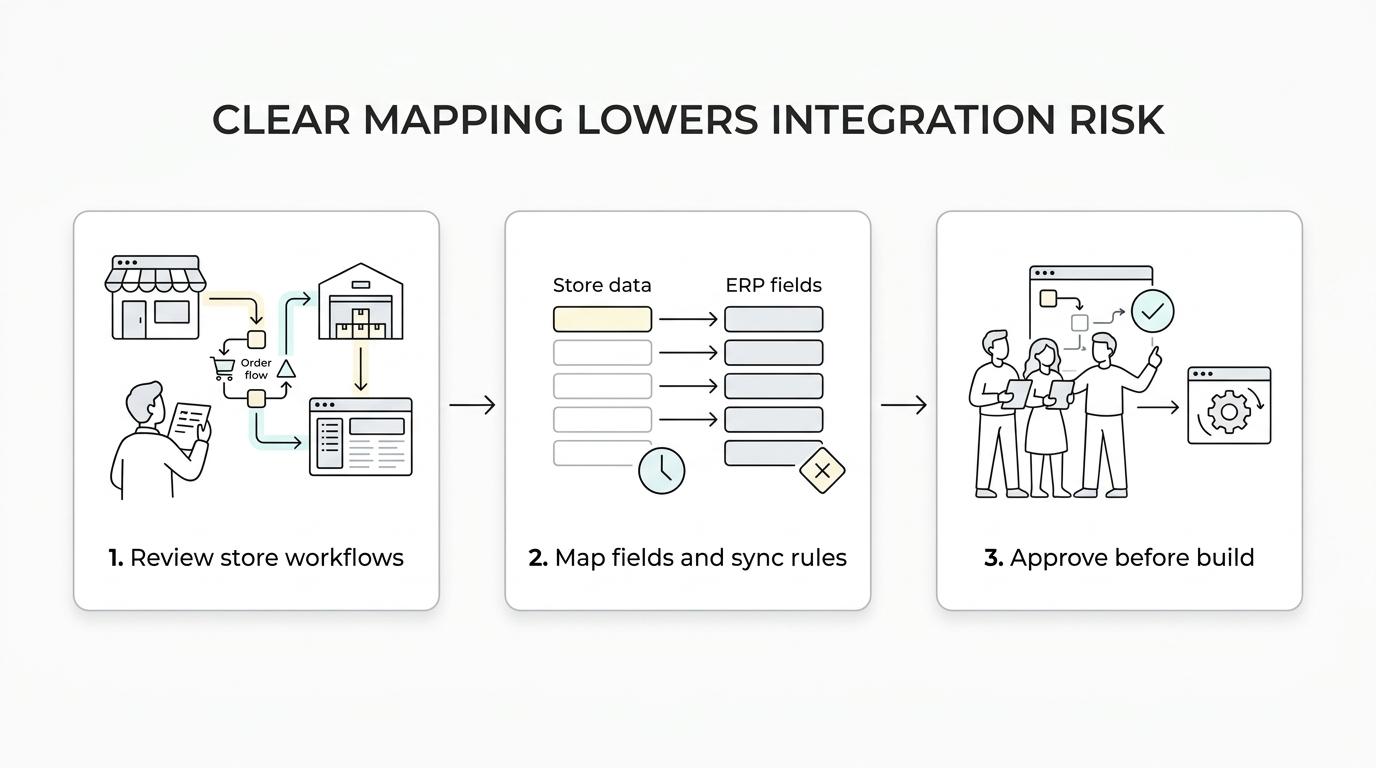
ERP projects often fail because the business logic and project management strategies, as well as the streamlining of processes, are unclear before development starts. Dahiya Decodes reduces that risk by leading with strategy and technical review first, then translating that into ERP integration decisions your team can validate before build work moves too far.
We start by understanding your store setup, order flow, catalog structure, fulfillment process, reporting needs, current system pain points, and how cloud services can be integrated to enhance these processes. From there, Dahiya Decodes defines the entities, fields, sync direction, timing, and exception handling that the ERP integration has to support so you know what is being connected and why.
“Dahiya Decodes keeps ERP integration founder-led and practical because retail ERP implementation is difficult, and unclear scope is where many projects go wrong.”
That early clarity helps with two common buying concerns: timeline and change risk. You are less likely to lose time rebuilding integration logic when ownership, field mapping, and approval points are agreed at the start.
During implementation, we can support custom ecommerce development, platform integration, CRM connections, payment gateway integration, automation, and analytics alignment so the ERP work fits into the rest of your commerce stack, enhancing customer relationship management. After launch, we support integration monitoring and error handling to help you see whether the integration is actually producing cleaner operations or just moving errors faster.
ERP integration with ecommerce security, authentication, and data integrity in mind
Store-to-ERP integration is not only about moving data. It also affects who can access systems, how transactions are validated, and how sensitive business processes are protected when APIs, admin tools, payment workflows, and customer actions interact.
NIST retail guidance has tied stronger authentication to online retail fraud reduction and has documented example approaches for both consumers and ecommerce platform administrators, including risk-threshold-based controls and open standards-based U2F options in retail environments. Dahiya Decodes uses that kind of grounded thinking to help you plan integrations that respect security, permissions, and operational control instead of treating them as afterthoughts.
For you, that means better questions get asked early. Which credentials will the integration use? How does the supply chain impact integration requirements? Which team members need access to what? What happens when an order fails to sync? Which actions need logs, retries, or manual review? Dahiya Decodes helps bring those issues into the project management scope before they become expensive problems.
Why stores choose Dahiya Decodes for ERP integration instead of a disconnected vendor stack
Many businesses end up splitting ecommerce development, procurement, paid growth, SEO, marketplace management, analytics, and ERP integration along with back-office integration across multiple providers. That can create delays when inventory feeds affect campaigns, order status affects customer communication, or catalog structure affects both search visibility and enterprise resource planning (ERP) data handling.
Dahiya Decodes is different because we work as a connected ecommerce development and growth partner, streamlining processes and utilizing real-time data and cloud services to ensure seamless integration and operational efficiency. Our team can look at ERP integration in the context of storefront behavior, paid traffic, marketplace operations, SEO, automation, analytics, and customer experience, which helps you avoid solving one issue while creating two more somewhere else.
Platform-aware solutions and recommendations, including ERP software integration, are another advantage, ensuring that scalability is built into your systems from the start. Dahiya Decodes does not force a fixed package or one-size-fits-all integration plan. We shape the work around your business model, system setup, ERP integration, channel mix, and operational bottlenecks to optimize operational efficiency so the solution fits how your store actually runs.
When Dahiya Decodes is the right ERP integration partner for your store
Dahiya Decodes is a strong fit when you need more than a developer who can “make systems talk.” We specialize in ERP integration and integrating business applications across multiple parts of your business, incorporating business intelligence, and you want one partner that can connect the technical work to commercial outcomes.
You are likely a good fit if:
- You run a growing online store: and manual exports, stock mismatches, or order reconciliation are slowing your team down.
- You sell across channels: and need your store, marketplaces, and internal systems, including ERP and order management system integration, to reflect the same operational reality.
- You need business-aware integration planning: not just API work, but clear decisions around ownership, ERP integration, integration monitoring and error handling, process, exceptions, and reporting.
- You want one connected ecommerce partner: across development, automation, analytics, customer relationship management (CRM), payments, and broader commerce operations.
If that sounds like your situation, Dahiya Decodes can help you scope the integration around what your store needs to improve first, whether that is inventory accuracy, data accuracy, order flow, reporting visibility, or a more reliable operational foundation for growth.
If you are planning an ERP integration for your store, talk to Dahiya Decodes about your current systems, sales channels, and operational bottlenecks. We will help you define the right integration scope, the key data flows, and the next steps needed to make your store easier to run.